
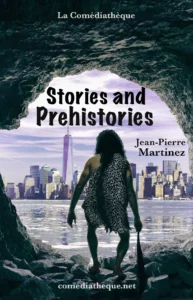
In Stories and Prehistories, contemporary society is represented through a symbolic and deliberately grotesque allegory. The plot initially appears simple: a group of rather crude individuals face basic survival challenges in an archaic environment resembling a dystopian version of prehistory. Yet this fictional world cleverly mirrors the realities of our own society, including its caricatured view of its distant origins. Very quickly, the intrusion of characters belonging to a modern world reveals to the audience that this is not a piece of heroic fantasy with prehistoric trappings, but an existential fable. This tension between a supposedly evolved civilisation and utterly primitive behaviour becomes the driving force of this symbolist social comedy, where each scene functions less as part of a traditional plot than as a parable about humanity.
1 – Semiotic analysis of the Play Stories and Prehistories
The narrative unfolds through a series of tableaux, each forming a small “mythology” of everyday life. Whether dealing with ego clashes, absurd rivalries, social rituals, or internal group tensions, each situation operates as a symbolic device revealing a deeper truth. The humour arises from the contrast between what some characters believe themselves to be — civilised, rational, modern beings — and what their actions actually display: primary, instinctive and often ridiculous behaviour.
Comedy emerges from this axiological inversion, where the most “primitive,” despite habits that may initially shock (such as cannibalism), ultimately appear more human than those first presented as civilised. It is a thinly veiled critique of modern civilisation and its evolution toward a polished form of barbarity.
The enunciation emphasises this symbolic treatment by stylising the scenes. The dialogues, often elliptical or deliberately offbeat, evoke archetypes rather than psychologically developed individuals. The set itself, barely specified, appears as an abstract, timeless space in which human invariants can be replayed. This distancing allows spectators to recognise universal dynamics. The aim is not to depict society as it is, but as it symbolises itself through its contradictions.
The connotative layer clearly situates the play within satire. By showing contemporary individuals trapped in archaic patterns of behaviour, Stories and Prehistories questions our relationship to modernity and the very questionable notion of “progress” in humanism.
The grotesque plays an essential role: it exaggerates what already exists, highlighting — with humour — the barbaric undercurrent present in our institutions, habits and social reflexes. Comedy becomes a tool for revealing what everyday life tries to conceal: our tendency to endlessly reenact the old scenarios of humankind.
Thus, Stories and Prehistories embodies symbolist social comedy, in which society is not described realistically but decoded through figures, motifs and symbolic inversions.
2 – Dramaturgical Analysis
The play relies on a structural anachronism that allows two worldviews to overlap: mythicised prehistory and highly technologised modernity. Martinez exploits the comic potential of this disjunction to expose the mechanisms of cultural domination. The first act establishes a form of grotesque realism in which daily survival — eating, hunting, tinkering, burying — intertwines with rudimentary yet coherent reasoning. The dramaturgy shifts with the arrival of the Newanderthals, inverted figures of progress: civilised in appearance, but predatory and cynical at heart.
The play functions as an evolutionary fable: each change of setting marks a transformation in the balance of power, culminating in the final reversal where the Bohosapiens — the “inferior species” — paradoxically inherit a post-apocalyptic world. Dark humour becomes a revelatory force: beneath the farce lies the collapse of the very mythology of progress.
Characterisation
Bohosapiens
They embody the archetype of a primitive clan: functional roles, simple needs, a chaotic patriarchal structure. Their flaws — naïveté, clumsiness, credulity — generate comedy but also tenderness. Each represents a social function (chief, hunter, artist, cook), allowing for an anthropological reading.
Newanderthals
Edouard and Jacky (Jacqueline) are their inverted counterparts: polite, modern, ironic… and deeply violent. They reproduce the role of “civilised” colonisers who view their neighbours with condescension, consume them literally and symbolically, and domesticate them. Their sophisticated language contrasts with their cultural brutality.
Relational Dynamics
The relationship between Newanderthals and Bohosapiens reenacts hierarchical patterns of domination, folklorisation and consumption of the Other. Symbolic violence merges with grotesque humour, creating a space that is at once playful and critical.
Structure and Narrative Dynamics
The play follows a five-act progression, each introducing a reversal:
- Act I: Introduction of the clan, hunting accident, initial imbalance
- Act II: Collective handling of the “crime,” early rumours of conflict
- Act III: Absurd diplomacy and arrival of the Newanderthals
- Act IV: Power inversion — domestication of the Bohosapiens, modern social satire
- Act V: Extinction of the Newanderthals, cyclical return to prehistory
The dynamic hinges on an amplification of the grotesque: justified cannibalism, absurd proposals, polite violence, role inversions. The narrative produces a continuum in which the boundary between progress and regression dissolves, revealing the instability of civilisation models.
Scope and Significance
Beyond the laughter, Stories and Prehistories offers a reflection on Western myths of evolution and supposed cultural superiority. By showing the “civilised” characters committing acts more barbaric than those of the “primitives,” the play reverses perspectives and denounces the ethnocentric bias that runs through human history.
The text also examines domestication: who civilises whom? who consumes whom? The human/animal relationship becomes a lens for criticising the commodification of life.
Finally, the extinction of the Newanderthals in front of the television serves as an ironic critique of contemporary cultural emptiness — a reminder that technological progress guarantees nothing when it comes to symbolic survival.
Usage rights — citation
Any use of excerpts or content from this analysis must include proper source citation.