
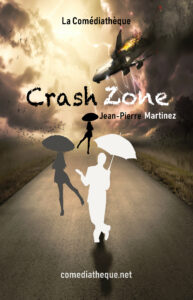
This analysis of Jean-Pierre Martinez’s Crash Zone is part of a broader study of contemporary French theatre, where the playwright explores the boundaries between the absurd and the metaphysical. In Crash Zone, the intimate is no longer the territory of everyday realism but the point of departure for a progressive deconstruction of reality. The play begins with a simple situation (three characters gathered to honour a missing relative), yet this familiar foundation quickly begins to crack. Reality seems to waver under the pressure of language itself: memories diverge, points of reference dissolve, and identities become blurred.
1. Analysis of Crash Zone (semiotic analysis)
The énoncé of the play rests on a quest—understanding what happened and clarifying an uncertain family tie—yet every attempt at explanation only deepens the opacity. Suspense is not factual but conceptual: words, memories, and hypotheses create the dramatic tension. The play advances not through action, but through fragile revelations, half-truths, and logical slippages.
Comedy emerges from this very instability: one sentence contradicts the previous one, a certainty suddenly collapses, an image becomes tangible by the sole force of speech. Laughter inhabits the fragile space between anxiety and fascination, where language generates unstable, shifting worlds.
The énonciation reinforces this sense of floating. The characters exist because they speak, and their speech becomes a lifeline—something they cling to in order not to sink into nothingness. The world around them exists only because they describe it, and they themselves exist only as witnesses to that fictional construct.
The stage becomes a mental landscape where elements of the décor (sea, cliff, rain, light) seem to emerge directly from their discourse. The goal is no longer mimesis but a theatricality of the spoken word, where imagination replaces representation. The spectator is drawn into a liminal zone between memory, fantasy, and madness.
The connotative level clearly evokes a surrealist vein: questioning identity, dissolving reality, and an ironic approach to the contradictions of the human mind. Nothing is truly terrifying, and yet everything slips away. The play establishes a subtle distance, allowing for both reflection and humour:
-
Why do we believe our own narratives so readily?
-
How does language shape our perception of the world?
-
How much fiction do we project onto our closest relationships?
Crash Zone thus epitomises the intimate surrealist comedy: a theatre of proximity in which the relational micro-cell becomes a laboratory of unbridled imagination, yet always anchored in human experience. The comic effect does not come from exaggerated burlesque, but from the vertigo provoked by reality’s dissolution. Beneath the apparent simplicity of its dialogue, the play opens a breach in the real and invites the spectator to embrace the poetic, fertile discomfort of doubt.
2. Characterisation
The three protagonists embody three attitudes toward non-sense, forming a kind of philosophical triangle: belief, doubt, and ritual.
Fred, emotional and malleable, drives the narrative. He desperately seeks meaning and multiplies hypotheses—about filiation, identity, orientation, DNA—until exhaustion. He carries the human need for narrative: the impulse to shape emptiness into fiction.
Dom, rational, caustic, and sceptical, represents lucid doubt. He resists “signs,” defuses overinterpretations, and acts as the rational counterweight to the group’s tendency toward delirium.
Yan, pragmatic, offbeat, and sometimes iconoclastic—arriving by plane, bringing a Paris-Brest cake, lighting a candle—embodies the rituals of consolation: moments of silence, photographs, symbolic gestures. She catalyses the play’s symbolic and poetic shifts.
Their dynamic rests on a perpetual imbalance: reason that doubts (Dom), belief that seeks (Fred), and ritual that soothes (Yan). Comedy arises from this constant friction between scepticism and credulity, with humour becoming the only shared ritual in the face of the absurd.
3. Structure and Narrative Dynamics
Crash Zone unfolds in a circular progression—almost in real time—mirroring the movement of an impossible investigation. The play opens with Dom and Fred arriving on the “crash site,” a deliberately vague location that is simultaneously a cliff, a void, and a theatre stage. Yan’s arrival triggers the ritualistic dynamic and the metaphysical drift.
The narrative advances not through events but through successive hypotheses. As the characters attempt to name the missing person, the fiction shifts: he becomes alternately brother, father, stranger, or even a figment of their imagination. This slide from plausible explanation to dizzying speculation transforms the play into a sequence of mental acts where speech is the only driver of action.
Everyday objects (the cake, the pen, the found note) punctuate this quest for meaning, acting as fragile beacons in a world without stable coordinates. The comedic dialogue spirals downward until the characters themselves begin to fade, trapped between memory and erasure.
The play closes with an ontological twist: the suggestion that perhaps they were never born at all. The final gesture—blowing out the candle—encapsulates the tension between being and nothingness, a reminder of how precarious every flame of existence truly is.
Thus, Crash Zone transitions from the dramatic (the airplane crash) to the existentially tragic (the erasure of self), oscillating between laughter and vertigo—hallmarks of Jean-Pierre Martinez’s dramaturgy.
4. Significance of the Work
Beneath its playful surface, Crash Zone unfolds a metaphysical meditation on the fragility of reality, memory, and filiation. The plane crash is merely a narrative pretext: the real crash is ontological—that of identity and meaning. Martinez examines how we construct beliefs and narratives to withstand absence and keep the world from collapsing.
The minimal device—three characters, an abstract location, a handful of trivial objects—highlights a dramaturgy of speech, where language is both a survival tool and a symptom of the void. The metatheatrical dimension is explicit: the cliff becomes the edge of the stage, the audience the abyss, and the actors’ performance mirrors humanity’s attempt to impose form on chaos.
This seemingly simple comedy confronts profound contemporary anxieties:
How do we mourn without a body?
How do we believe without proof?
How do we exist without origin?
In a world saturated with images and narratives, the comforting signs (rainbow, photograph, candle) appear as fragile simulacra.
Through this darkly humorous and symbolic play, Martinez paints the portrait of a humanity suspended between illusion and lucidity, condemned to laugh at its own dizziness to avoid falling silent.
5. Conclusion
By ending Crash Zone with the extinguishing of a candle, Jean-Pierre Martinez offers an allegory of the human condition: the flickering light of consciousness before the return to darkness. With gentle irony, the play extends the existential questioning at the heart of his work: we laugh in order not to disappear completely.
At the crossroads of the Theatre of the Absurd and metaphysical tragicomedy, Crash Zone reinvents the stage as a space of vertigo—a place where the void becomes poetic material and where speech, however fragile, remains our final shield against silence.
Through its formal simplicity and symbolic depth, the play stands as a contemporary meditation on memory and disappearance, placing Martinez among those dramatists who use humour as an instrument of lucidity.
The spectator, confronted with the abyss, leaves this crash zone with the paradoxical feeling of having touched both nothingness and the grace of theatre.
Usage rights — citation
Any use of excerpts or content from this analysis must include proper source citation.