
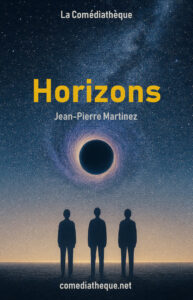
Horizons presents itself as a deceptively minimal piece: three characters, an empty stage, a line of light suggesting an impossible horizon. Yet this extreme simplicity functions as the very condition of its symbolic density. The horizon — a perceptual limit, an optical illusion, a metaphysical threshold — becomes the structuring matrix of the entire dramatic device. It is at once a place, a boundary, a promise, and a void: the metaphor of every “beyond” that the human mind cannot reach and yet never ceases to imagine.
1 – Analysis of Horizons (semiotic analysis)
Ben, Dom, and Max — amnesiac, rootless, stripped of identity — attempt to reconstruct some semblance of meaning in a universe where all external coordinates have disappeared. Their successive hypotheses (a plane crash, a coma, a mountaineering accident, an Alzheimer’s ward, a spaceship falling into a black hole) do not form a plot but rather an ontological wandering. They speak in order to exist, and it is from this fragile verbal fabric that the piece draws its dramaturgy.
Ultimately, Horizons interrogates the foundations of human meaning-making:
-
existential (who are we when memory dissolves?),
-
metaphysical (are we alive, dead, dreaming, or already beyond?),
-
cognitive (what remains of knowledge when the self is erased?),
-
linguistic (does language reveal the world or produce it?).
The horizon is not merely what the characters look at — it becomes the mirror of their consciousness, the vanishing point of their identity, and the symbolic locus where sense collapses and reconfigures itself.
2. Analysis of the Enunciated (the Represented World)
2.1. A Minimal, Indeterminate Diegetic Space
The stage is bare, lit by an unreal glow that effaces any trace of realism. Space and time are undefined. The scene resembles neither Earth nor afterlife, neither hospital nor cockpit. This indeterminacy is central: the world is not represented but generated by the characters’ tentative discourse. The horizon, which does not materially exist onstage, is conjured only by their gaze and their speech. It stands for the unknowable — a symbolic line across which meaning disappears.
2.2. Characters as Semiotic Figures: A Trinity of Consciousness
Ben, Dom, and Max are not psychological characters but allegorical facets of a divided mind:
-
Ben – Reason: he formulates hypotheses, seeks coherence, and tries to organise chaos.
-
Dom – Doubt: cynical, sardonic, the voice of scepticism, exposing the absurdity of ready-made truths.
-
Max – Imagination: dreamlike, intuitive, the bearer of visions (plane, void, black hole) that reorient the dramatic space.
Together, they constitute a triadic consciousness, a single mind in crisis, split into reason, imagination, and negation. Their interactions resemble the inner dialogue of an entity attempting to rediscover itself after a metaphysical rupture.
2.3. Isotopies and Recurring Motifs
Several isotopies shape the semantic field of the play:
-
The Horizon: limit, illusion, desire, death, the invisible.
-
Memory / Forgetting: identity reduced to almost nothing.
-
Plane Crash / Fall: rupture with empirical reality.
-
Black Hole: absolute opacity, collapse of meaning.
-
Hospital / Coma: suspended consciousness, borderline life.
-
Cord / Rope Team: solidarity and peril in the void.
These motifs do not build a coherent narrative; they crystallise successive attempts to stabilise meaning — attempts that always fail, revealing the inherently unstable nature of existence.
3. Analysis of the Enunciation (Production of Meaning)
3.1. Unstable Polyphony and Floating Address
There is no privileged voice. Each character attempts to impose a hypothesis, only to see it contradicted or dissolved. The polyphony itself becomes the structure of the play. Their dialogue seems addressed simultaneously to each other and to an invisible beyond — the audience included — as though the stage were a threshold between this world and some indeterminate elsewhere.
3.2. Language, Absurdity, and Existential Survival
The linguistic texture resembles the theatre of the absurd: circular exchanges, contradictions, clichés, logical short-circuits.
But unlike classic absurdism, this isn’t nihilism — it is a survival mechanism. The characters speak to resist dissolution: “As long as we’re talking, it means we’re not dead yet.”
Paradoxically, language reveals its own insufficiency: quotations half-remembered, scientific notions mangled, metaphors collapsing. The play exposes language both as the last refuge of meaning and as the prison that prevents access to the real.
3.3. Scientific Discourse as Metaphysical Poetry
Astrophysics and quantum mechanics — event horizons, singularities, superposition — are invoked not for realism but for their symbolic power. They express: the limit of perception, the indeterminacy of existence, the possibility of being dead and alive simultaneously, the collapse of time at the edge of being. Science becomes the new metaphysics, the poetry through which the modern mind articulates its terror and wonder.
3.4. The Spectator as Fourth Consciousness
Because the spectators know no more than the characters, they share the same epistemic void. They, too, experience the horizon as an enigma. The audience thus becomes the fourth component of the divided mind the play stages — the witness of an inner drama that could be their own.
4. Denotation (the Literal Level)
Literally, the play shows: three people facing an invisible horizon, a rope that once bound Dom, an empty stage, minimal gestures, time suspended, speech as the sole form of action.
Nothing concrete happens. The diegetic events are hypothetical, imagined, reconstructed, or retracted. The visible is reduced to its strict minimum so the symbolic can expand infinitely.
5. Connotation (Symbolic and Metaphorical Dimensions)
5.1. The Horizon as Total Metaphor
The horizon condenses all major semiotic oppositions:
-
visible / invisible
-
here / beyond
-
life / death
-
knowledge / mystery
-
language / silence
-
being / non-being
Like a black hole’s event horizon, it marks the threshold beyond which meaning collapses — and perhaps reemerges in another form.
5.2. Memory, Identity, and the Dissolution of the Self
Amnesia becomes the parable of a deeper condition: identity is fragile, contingent, relational. Without memory, the self disintegrates. The characters become interchangeable figures, variations of one another, expressing a collective “I” in the process of vanishing.
5.3. Science and Metaphysics: Coexistence of Incompatible Worlds
Scientific metaphors illuminate metaphysical questions:
-
The event horizon → limit of consciousness.
-
Quantum superposition → coexistence of contradictory states (alive / dead).
-
Cosmic cycles → reincarnation, renewal, endless repetition.
The scientific and the spiritual fuse into a single symbolic system.
5.4. Circularity of Time
The play’s structure is spiral-like. Each interpretive attempt collapses into doubt. The ending mirrors the beginning. Time behaves like a relativistic horizon: constantly receding, never graspable.
6. Typological Positioning: Symbolist Intimate Comedy
Comedy
Humour permeates the piece — ironic, self-deprecating, sometimes bleak. It softens existential terror, allowing the spectator to contemplate the abyss without falling in. The comedy lies not in situations but in the impossibility of making sense of existence.
Symbolist
Nothing is realist. Everything is sign.
The empty stage, the rope, the horizon, the flashes of memory, the scientific references: all are symbolic condensations of an interior drama.
Intimate
The intimacy is ontological rather than psychological. Ben, Dom, and Max are three voices of a single consciousness confronting itself. The interpersonal is a metaphor for the intrapersonal.
A Unique Piece in Martinez’s Body of Work
Unlike his societal comedies, Horizons is stripped of context and realism. It explores humanity not socially but cosmically, metaphysically. It is perhaps Martinez’s most abstract and deeply introspective play, marrying humour and metaphysics in a rare equilibrium.
7. Global Semiotic Logic
Underlying Semiotic Square
| Life | Death | |
|---|---|---|
| Consciousness | Speech, questioning, doubt | Collapse of meaning |
| Unconsciousness | Renewal, rebirth | Total dissolution |
Three Ontological Dimensions
-
Virtual: all the hypotheses (plane, coma, mountain, spaceship).
-
Actual: speech — the only stable reality.
-
Real: absent, inaccessible, beyond the horizon.
The play enacts the very process of meaning-making: each hypothesis opens a world, then vanishes, leaving only the fragile persistence of existence.
8. Conclusion
Horizons is a metaphysical comedy of striking poetic force. In a bare space, three fractured facets of a self attempt to reconstruct meaning from scraps of memory, scientific metaphors, and everyday idiocy. The play examines:
-
the fragility of identity,
-
the limits of knowledge,
-
the cyclical nature of life and death,
-
the prison and necessity of language,
-
the irreducible human need to project meaning toward an unreachable horizon.
The final gesture — the three characters roped together, advancing into the unknown — encapsulates the paradox of human existence:
we walk toward a horizon we cannot reach, hoping to find meaning beyond it, knowing full well it will recede forever.
Usage rights — citation
Any use of excerpts or content from this analysis must include proper source citation.