
Jean-Pierre Martinez’s Comedies by Genre
Theatrical Dramaturgies, a Dynamic Typology of Theatrical Genres
One can perfectly well write a play without having studied dramaturgy, just as one can compose a piece of music by ear without having studied music theory.
This simply means that one instinctively applies the rules of harmony — or of dramaturgy.
It does not mean that such rules do not exist.
Jean-Pierre Martinez, both linguist and writer, casts an analytical eye here on the history of theatre as well as on his own dramatic work, in order to establish a mapping of theatrical genres — conceived not as a normative system, but as a basis for reflection and an invitation to creativity.
With this short essay, he wishes to share his theoretical and practical expertise in dramaturgy with all those who make theatre today, or who take an interest in it: playwrights, directors, actors, but also researchers, teachers, students… and simply passionate spectators.
Table of Contents
Foreword
Current “typologies” of theatrical genres tend to resemble a miscellaneous inventory. They adopt primarily a historical perspective, listing the genres that have existed (many of which no longer exist in their original form) and relying both on content and form without articulating the relationship between these two dimensions. These are merely open-ended catalogues that label the diversity of theatrical practice without truly explaining it.
Since Antiquity, very few have attempted to produce a reasoned typology of theatrical genres. Today, we are left with a choice between interminable lists drawn up by theatre specialists lacking specific knowledge of language theory, and typologies reduced to only a handful of genres (comedy, tragedy, and drama, for example) devised by theorists with no personal practical experience in dramatic writing for the stage.
Typologies devoted specifically to comedy are somewhat more precise, but they rely on distinctions between procedures that in practice are almost always extensively combined: comedy of character, comedy of manners, comedy of situation, comedy of intrigue, boulevard comedy, farce, and so on. A successful comedy generally belongs to all these categories at once: it refines character construction, shapes a well-structured plot, incorporates a discreet measure of social satire, and seeks the approval of a wide and popular audience.
This essay proposes a structured and dynamic typology of theatrical genres. The method is neither inductive (observing the diversity of theatrical genres and attempting to classify them empirically), nor deductive (starting from a theoretical organisation designed to generate predefined categories into which the various forms of theatre may be placed), but hypothetico-deductive: constructing a hypothetical model based on the observation of theatrical phenomena, then validating that model by verifying that it is indeed capable of re-generating all the virtualities of theatrical dramaturgy.
This model, broad in scope and deep in structure, may, of course, be refined and supplemented in the future to account for the more superficial dimensions of the theatrical creation process.
From analysis to creation…and ultimately to the analysis of one’s own creation
Originally trained as a semiologist, I took part in the 1980s in the work of the Paris School of Semiotics under the direction of its founder, Algirdas Julien Greimas, Roland Barthes’s close collaborator and successor as the leading figure of French semiological research. Like Umberto Eco, however, I see myself as both a linguist and a writer. I therefore turned to screenwriting before devoting myself exclusively to theatre.
A prolific author, I have written more than 120 plays over the course of a few decades, forming a theatrical universe that is both original and remarkably coherent, and a literary corpus exceptional not only in its diversity but also in its scope. My works are now performed across the world and studied from secondary school to university level.
In my writing, I rely on the solid foundations I acquired in narratology as a researcher at the École des Hautes Études en Sciences Sociales. Yet I also cast, when the occasion arises, an analytical eye on my own theatrical work. It is this linguistic and literary expertise that I wish to share with all those who make theatre today, or who take an interest in it, whether playwrights, directors or actors, but also scholars, teachers, students… or simply passionate spectators.
This short essay is, for me, a way of closing the circle of my professional, intellectual, and even existential journey: from the study of linguistic theory to literary creation… and ultimately to the self-analysis of my own theatrical work.
Part 1 – From the Representation of the World to Theatrical Representation
Chapter 1 – The Process of Theatrical Creation
From a semiotic perspective, theatrical dramaturgy (understood as the process through which a performance intended for an audience is produced) may be analysed as unfolding in three stages:
Selecting a mode of representation
This involves establishing a specific type of langage prior to any production of meaning. In other words : what kind of relationship between signifier and signified is chosen to express one’s intent ? To speak about the world, theatre (but also literature as a whole, as well as the visual arts) may opt for a mimetic langage, or for various other forms of rhetorical relation between signifier and signified (the symbolic mode, for example).
Developing a dramatic project
This is the articulation, both in discourse and on stage, of a specific proposition through the utterance (the story being told, which is not unique to theatre) and through the enunciation (the manner in which that story is told using the tools and codes specific to theatre). Put another way: how does theatre convey its vision of the world through one particular dramatic text? The expression “dramatic text” should not be taken here in the narrow sense of a written or printed text. It refers instead to the dramatic project as a whole, which encompasses both the text and the envisaged staging, whether the project is entirely written in advance or whether it also involves a form of “devised process” that incorporates aspects of the staging itself.
Producing a theatrical performance
This is the actual transmission of the dramatic project to an audience in the form of a theatrical performance. A key issue here is the interpretative contract established by the theatre with its audience concerning the performance. Pure tragedy relies primarily on denotation and therefore on a first-degree reception, whereas comedy introduces, through connotation, a critical distance from its own discourse: the audience is invited to receive the performance on a second level, as carrying an implicit commentary on both its content and its form.
It is the combination of the choices made across these three dimensions of the theatrical process that allows for the construction of an exhaustive typology of theatrical genres.
Modes of Representation
The Relationship to the World
Theatrical genres belong to a broader history of artistic expression that includes literature as well as the visual arts. It is therefore necessary, first of all, to situate the diversity of theatrical forms within a model capable of accounting for the wider variety of movements that have shaped the history of art as a whole.
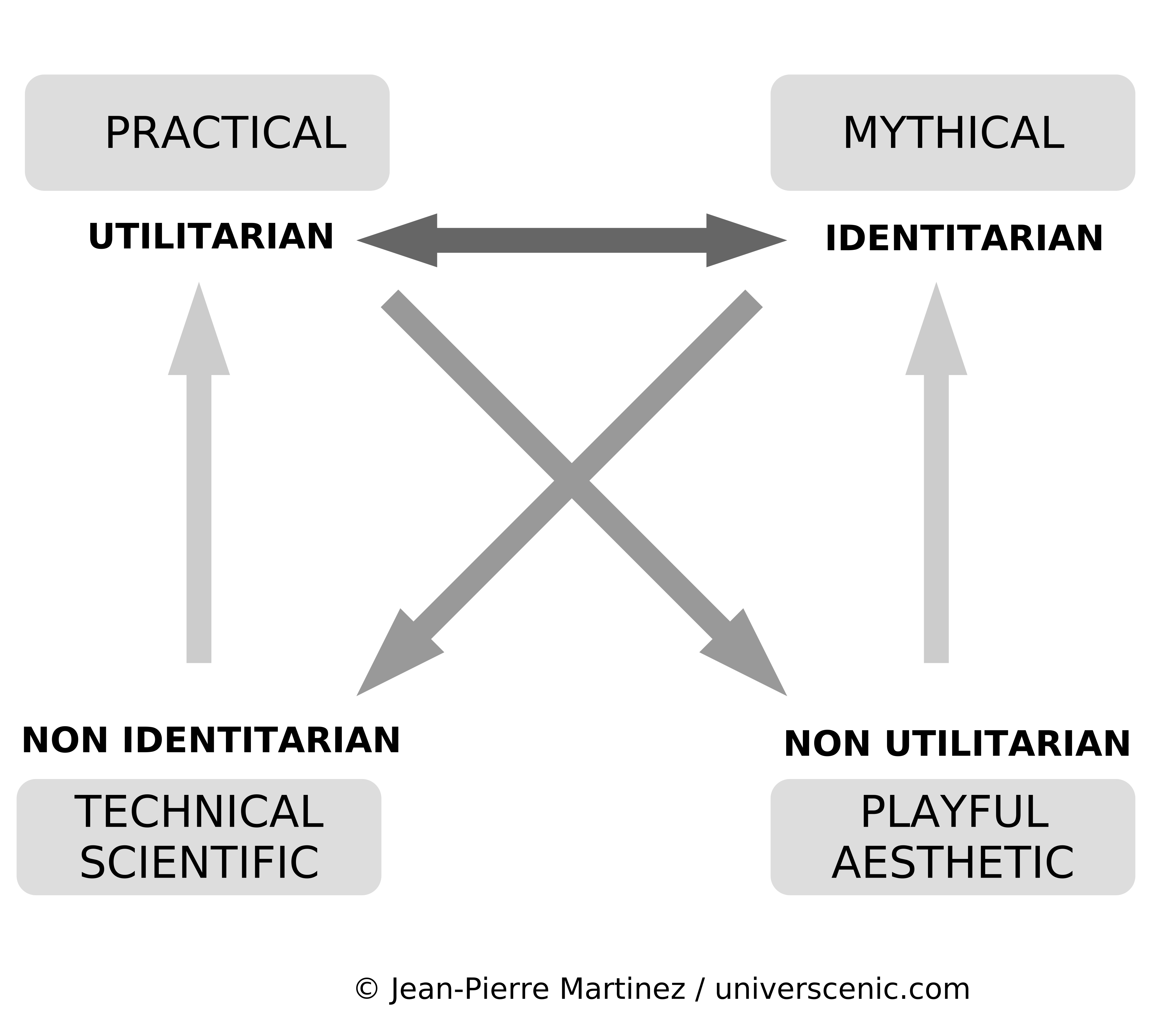
To this end, we draw on a model developed within semiotics (the study of sign systems) in order to map, by means of a structured framework, a field of meaning. The semiotic square is a logico-semantic tool that is at once static (it defines positions) and dynamic (it suggests possible pathways).
For any given semantic field, such as the type of relationship human beings establish with the world to which they belong, the semiotic square is organised around an initial axis of opposition between two contraries. In the present case: the utilitarian (pertaining to the practical) versus the identitarian (pertaining to the mythical). The other two positions of the square are generated by applying the logical operation of negation to each of these terms: here, the non-utilitarian (what serves no practical purpose: the playful, the aesthetic) and the non-identitarian (what is deliberately stripped of symbolic charge: the technical, the scientific).
The logical dynamic of the semiotic square proceeds by negating one term and then asserting its opposite. Ultimately, the model thus defines four positions governed by three types of relations: contrariety (between the contraries), contradiction (between a term and its negation), and complementarity (between the negation of one term and the opposite of that term).
This fundamental and highly structuring anthropological model accounts for four modes of being-in-the-world that humanity has experienced, whether successively or simultaneously, throughout its history.
The Practical Mode
Human beings inhabit a world without depth, a world of which they are a part and upon which they act for their own benefit, first simply to survive, and later to construct a comfortable living environment. At this stage, humans do not seek to assign meaning to the world; they simply use and shape it in order to satisfy their material needs. This mode of being-in-the-world is undoubtedly the most primitive, and humanity shares it with the animal kingdom, whose primary aim, whether individual or collective (as in the case of social species), is survival through adaptation to the environment and the optimal exploitation of its resources.
The Playful and Aesthetic Mode
Once survival and a certain degree of comfort have been secured, human beings develop activities that are no longer directly utilitarian, oriented instead toward the pursuit of pleasure, whether playful or aesthetic. Humans no longer merely use the world: it becomes at once a playground and a source of astonishment and wonder. It is at this stage that humanity begins to distinguish itself from animals, notably through the emergence of artistic activity.
The Mythical Mode
Human beings no longer perceive the surrounding world solely as an environment to be used or as a source of hedonistic pleasure. They begin to question the meaning of their own existence and the possibility of a reality beyond the material world. The world becomes the mysterious signifier of a signified that must be discovered. This marks the birth of philosophy and religion, accompanied by the first funerary rites, which attest to humanity’s existential need to imagine an afterlife, beyond the individual after death, beyond this world upon leaving it, and beyond human time once death deprives the present of any future.
The Technical and Scientific Mode
n reaction to this uncertain, perhaps even futile, quest for meaning, human beings may renounce the idea of treating the world as an allegory whose deeper significance must be deciphered, and instead regard it as an object of rational enquiry. This leads to the development of applied technologies as well as the fundamental sciences, in the search for an explanation of the world not through symbolic interpretation but through observation and experimentation.
Using this extremely general model, one can organise the various artistic movements, and their sometimes cyclical historical succession, according to the type of relationship they claim to establish with the world in the broadest sense. For every art form proposes a particular mode of relating to the world it seeks either to represent mimetically or to interpret symbolically.
The Representation of the World in Theatre
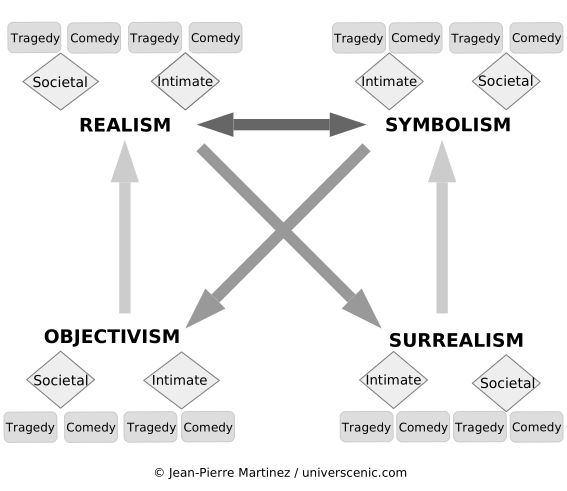
The four types of relationship that art, and dramatic art in particular, may establish with the world in order to create a language prior to any discourse are the following:
The Realist Mode
Realism (and its tragic variant, naturalism) seeks to reproduce reality more or less faithfully in order to produce an effect of verisimilitude. Realism relies on this effect of the real to offer the audience an edifying and/or critical vision of the world.
The Surrealist Mode
What will be referred to here as surrealism in a broad sense, while taking ordinary reality as its point of departure, aims to make the narrative tip over into the fantastic. Surrealism opens a door onto a realm beyond the real, one considered ultimately truer and more meaningful than the familiar world.
The Symbolic Mode
Symbolism breaks entirely away from reality in order to stage an imaginary world conceived as an allegory of the real one. Symbolism offers an interpretation of reality in the form of a mythical narrative designed to reveal the hidden meaning of the ordinary world, which would otherwise remain imperceptible and incomprehensible.
The Objectivist Mode
What will be referred to here as objectivism constitutes a return to the essence of a reality stripped of all symbolic charge. Objectivism proposes an unfiltered apprehension of reality in order to highlight the nature of things themselves, described with a minimum of artifice.
Developing the Dramatic Project
In theatre, each mode of meaning is realised through the development of a theatrical text as utterance (what is being told) and as enunciation (the manner in which it is told). The chosen mode of meaning also presupposes, upstream, a certain type of relationship proposed to the audience regarding the performance they are about to witness.
The Realist Project
The utterance is characterised by plausible situations (even if they may appear exceptional): ordinary characters, familiar spatial settings, logical action, and linear temporality.
The enunciation is defined by adherence to the traditional codes of theatre: the staging of fictional characters linked to the plot (thus excluding any onstage incarnation of the author, the director, the stage manager… or the spectators), respect for the fourth wall, and narrative time following the time of the action.
The identification proposed to the spectator with one character (or possibly a group of characters) in the play is based on point of view. The spectator is invited to identify with the character through whose perspective the story is approached. The spectator discovers events alongside them and shares their thoughts and emotions. This is psychological identification.
The Surrealist Project
The utterance is characterised by a disruption of the laws of ordinary reality: strange characters, uncertain spatial settings, illogical action, and disturbed temporality.
The enunciation may also deliberately violate traditional theatrical codes: intrusion of the author (or even of the spectators) into the story, disregard for the fourth wall, and narrative time no longer following the time of the action.
The identification of the spectator with any particular character, though theoretically possible, is destabilised by the unreality of the utterance and the irrationality of the enunciation.The instability of point of view and the incoherence of the characters make it difficult for the spectator to identify with any particular figure. Identification becomes diffuse, multiple, kaleidoscopic. This is floating identification.
The Symbolist Project
The utterance is characterised by the staging of a parallel imaginary world governed by its own rules, regarding the characters and their physical or psychological traits, the spatial and temporal frame of reference, and even logic itself.
The enunciation does not merely violate traditional theatrical codes: it creates its own. Dance, lighting, or music may partially or entirely take the place of dialogue as the means through which the utterance is conveyed, and the very notion of a separation between stage and auditorium may give way to an alternative configuration, including immersive ones.
The identification of the spectator with a particular character relies not on psychological traits but on ethical values. The spectator is invited to identify with the character who embodies positive values (goodness, justice, truth). Identification is moral and Manichaean. This is ideological identification.
The Objectivist Project
The utterance is characterised by a deliberately asserted minimalism: barely sketched characters without psychological depth, schematic spatial settings and absence of scenery, very short narratives. The dramatic work appears as a succession of moments caught in the instant, slices of life, snapshots… It is the sketch, or the series of sketches.
The enunciation likewise adopts a deliberately economical use of theatrical codes: minimal or no lighting effects, no transitions between scenes, fragmentation effects…
The identification of the spectator with any character is rendered impossible by the deliberately established distance from the utterance, producing an objectifying and therefore depassionate gaze. The spectator remains external to the characters and to the story, which they simply observe and analyse. This is neutralised identification.
From the Intimate to the Societal
Each of these relationships to the world may be approached from either an individual or a collective perspective.
What pertains to the individual and the intimate invites reflection on the life and experience of a specific subject (psychological or psychoanalytic introspection), on the family unit, on the circle of friends, on conjugal life…
What pertains to the collective and the societal invites reflection on life in society (from sociology in the broad sense to the collective unconscious) and on social life in all its forms (professional, communal, political…).
However, the transition from the individual and the private sphere to the collective and the public sphere is, of course, gradual. Between pure introspection, in other words a dialogue with oneself, and societal debate, there may exist all possible intermediate stages. Neighbourly relations, for instance, form the hinge between the private and the public sphere: the neighbour is no longer a stranger, yet not quite an intimate.
The Production of the Theatrical Performance
Once a discourse (a dramatic, literary, or pictorial work, for example) is presented to the gaze and judgment of an audience, it inevitably carries, beyond its denotation (its reference to an objective element of the world), a connotation (an additional layer of subjective meaning projected onto it by its recipient). Thus classical tragedy as a whole is regarded as a noble, elitist genre, supposedly addressed to a highly educated audience, whereas comedy in general, and even more so so-called “boulevard theatre”, is considered a popular, even vulgar form.
These traditional connotations of tragedy and comedy, originating in the history of theatre, are not, however, fixed once and for all. While contemporary comedy as a whole is still widely perceived by the theatrical institution and by an elitist audience as a minor genre, the classical comedies of Molière or Shakespeare have, together with their authors, acquired full cultural legitimacy. Conversely, the more modern and popular descendants of tragedy, namely drama, and especially melodrama, carry a popular connotation and are regarded as inferior genres.
By definition, therefore, while the denotative content of any work remains stable, its connotation varies according to period, cultural sphere, and audience. Thus “boulevard theatre”, once scorned by the elites, may itself be ennobled by those same elites as its authors become classics (as in the case of Georges Feydeau or Sacha Guitry) and receive the consecration of the Comédie-Française.
Similarly, theatre originating from the French South, initially dismissed as regional (if not folkloric) by Parisian elites and consequently confined to playhouses in Marseille, was able, through Marcel Pagnol, to gain a degree of national institutional recognition following a triumphant première in Paris, even though Pagnol’s theatre as a whole remains unjustly undervalued today and is still viewed with a measure of condescension by certain elites.
The Tragic and the Comic
Since connotation is by nature variable, one cannot construct a stable typology of genres on this basis (for example: minor versus major genre, popular versus elite genre, vulgar versus noble genre). By contrast, the distinction between tragedy and comedy remains productive as a set of possible declensions of each mode of theatrical meaning.
Indeed, in theatre, every dramatic text can be realised either in a tragic version or in a comic one, depending on the point of view the author adopts in relation to their project and, consequently, the position they invite spectators to adopt in relation to the performance they are about to witness.
Tragedy is entirely centred on the seriousness of its subject: the narrator adheres fully, without distance, to the narrated and to the narration, to the point of effacing themselves completely behind the story.
Comedy, by contrast, thrives on complicity between narrator and audience, who are encouraged not to take too seriously what they are being told and to derive from the performance a secondary message, sometimes even contrary to its literal meaning (cf. irony).
The Realist Performance
The realist mode of representation, whether tragic or comic, finds its most perfect illustration in the classical period of European theatre, often regarded as its golden age (the 17th century).
Realist tragedy (or its less fatalistic variant, realist drama) establishes no distance between enunciator and utterance.
By intensifying intimate or social conflicts and by heightening individual or collective passions, the enunciator invites the audience to complete, first-degree immersion in the story and to direct identification with its protagonists. This is catharsis, whose aim is to move and thereby to edify
Realist tragedy also seeks to preserve the codes of classical dramaturgy, fully internalised by the audience, so as not to draw attention to the artifice of theatrical representation, itself another means of contributing to the effect of reality.
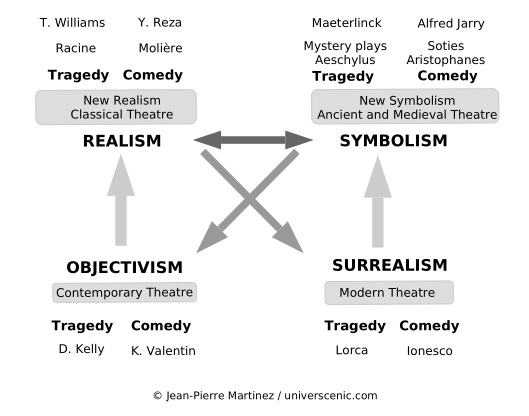
This includes the corpus of classical tragedies, notably French (Racine) and English (Shakespeare), whose narratives unfold within a realistic historical context, often featuring real historical figures and events. Among these tragedies, some focus chiefly on individual destinies, others on collective destinies, the two dimensions generally being closely intertwined, as great history is told through the lived experience of those who both endured it and shaped it. Realist tragedy continues into the modern period with authors such as Tennessee Williams (A Streetcar Named Desire, The Glass Menagerie) and Arthur Miller (The Crucible, Death of a Salesman).
Realist comedy, on the other hand, establishes a critical distance between the author and what is being told, offering spectators the same distancing effect in order to provoke laughter. Realist comedy caricatures the situations and passions it depicts in order to ridicule them, leading the audience to condemn and mock them. This is satire.
Parody arises when realist comedy caricatures not only social or psychological traits but also the very codes of the genre itself, as in the case of melodrama.
Molière is, of course, the supreme master of realist comedy. Moreover, many of his comedies, through their deliberate excess, are themselves caricatures of the genre, creating an additional comic effect. Following Molière, the success of realist comedy has never waned, with countless authors around the world continuing to sustain this tradition (Georges Feydeau, Neil Simon, Yasmina Reza…).
The Surrealist Performance
The term surrealist is used here in a broad sense, encompassing, among other things, the theatre of the absurd. The surrealist mode of representation includes much of modern theatre, especially European theatre from the first half of the twentieth century, which positioned itself in reaction to the themes and codes of classical theatre by reversing them and/or mocking them.
Surrealist tragedy stages the same intimate or societal conflicts and the same individual or collective passions, still received at the first degree, but this time by derailing logic toward the absurd and tipping reality into the fantastic.
Surrealist tragedy may also seek to subvert the codes of classical dramaturgy in order to foreground the artifice of theatrical representation and create an effect of dramatic estrangement. This is what is now called meta-theatre.
Examples include certain plays by Lorca (When Five Years Pass) or Vitrac (Victor, or Power to the Children). Yet Shakespeare is already, in many respects, a modern author: some of his plays, such as Hamlet, which combine the fantastic with self-reflexive structures, belong at least in part to surrealist tragedy.
Surrealist comedy adds a caricatural dimension to this fantastic narrative in order to provoke laughter.
Surrealist comedy may also humorously subvert the very codes of the genre, notably through the use of theatre-within-the-theatre, this time in a comic rather than philosophical register.
One may cite Ionesco’s theatre, which simultaneously plays on the shift into the absurd and on the subversion of theatrical codes (The Bald Soprano).
The Symbolist Performance
The symbolist mode of representation, whether tragic or comic, lies at the very origins of Greek and Roman antiquity, as well as of medieval European theatre.
Symbolist tragedy stages intimate conflicts (individual passions) or societal ones (collective passions). In the first case, the effect tends toward a waking dream (oneirism); in the second, toward a dystopia. In both cases, reality is transposed so that it may be questioned and interpreted.
The theatrical codes used in symbolist tragedy (signifying costumes, stylised sets, dreamlike lighting, symbolic colours) contribute to expressing this allegory with its poetic and interpretative aims.
Ancient Greek and Roman theatre, in its mythical dimension, fully belongs to symbolist tragedy. Medieval European theatre does too: the Mystery plays (societal dimension) and the Morality plays (intimate dimension). In the classical period, one may cite Calderón’s Life Is a Dream. In the modern period, Maeterlinck’s Pelléas and Mélisande.
Symbolist comedy likewise stages intimate or societal conflicts. In the first case, the result is a comic absurdity; in the second, an exaggerated dystopia, even a parody.
Its codes (excess, transgression, deliberate vulgarity, the grotesque) aim to challenge the conventions of traditional bourgeois theatre.
Greek and Roman comedy (Aristophanes) also participates in symbolist comedy. Medieval soties fully belong to this genre. Medieval farces, which mock the vices of ordinary people, by contrast anticipate realist comedy, which would later reach its full expression in Molière. In the eighteenth century, one may cite Marivaux’s The Isle of Slaves. In the modern period: Jarry’s Ubu Rex.
The Objectivist Performance
The objectivist mode of representation appears only in the contemporary period. Authors who have cultivated this genre exclusively are relatively rare, and works belonging solely to this type are likewise uncommon. Moreover, because of its experimental, nonconformist, even underground nature (cf. Spanish micro-theatre), this form is not well catalogued, and its authors are not necessarily widely known.
Objectivist tragedy seeks to show and dissect individual or social reality in a spirit of testimony and inventory. The utterance is sober and factual. Facts are left to speak for themselves. This includes the minimalist writing found in Spanish micro-theatre.
The enunciation is devoid of all artifice. The codes employed may be borrowed from cinema or documentary in order to produce an effect of objectivity. The narrative is fragmented and fragmentary. Flashbacks or flash-forwards may be used; narrative time no longer follows the time of the story.
To illustrate this recently emerged genre, one may cite Dennis Kelly’s Orphans or DNA, and Sarah Kane’s 4.48 Psychosis.
Objectivist comedy consists of the sketch-like or fleeting evocation of individual or social anecdotes treated in a deliberately summary or partial manner. It is often short, sometimes a brief scene, a sketch, or a sequence of more or less autonomous moments whose combined significance illuminates a single idea. Its theatrical codes rest on an accentuated, self-mocking minimalism.
Examples include Václav Havel’s Vernissage, Nathalie Sarraute’s For a Yes or No, and the sketches of Karl Valentin.
The Mixing of Genres
It is important to note that this combinatory semiological typology, though it exhaustively defines the full range of possible theatrical genres, does not in any way preclude an author from mixing genres within a particular work. Indeed, this deliberate blending of genres (especially comedy and tragedy) is among the qualities that mark the modernity and genius of William Shakespeare.
The fact that the model can be transgressed does not call its validity into question. In other words, although this typology is explanatory and predictive, it is in no way normative or prescriptive. It is a tool (among others) to be used, not a rule to be followed.
Many authors, over the course of their careers, have explored multiple genres. This is the case of Jean-Pierre Martinez, whose body of work will now be examined more specifically in the light of this typology.
Chapter 2 : The Theatrical Work of Jean-Pierre Martinez
In this singular exercise in self-analysis, the semiologist I once was takes as his object of study the theatrical work of the playwright I have become. Speaking of myself in the third person is therefore not an act of immodesty, but the necessary distancing required of any analyst with regard to their field of investigation. For an identical utterance, this procedure also illustrates the essential role played by enunciation in any discourse. First-person enunciation immediately establishes a sense of complicity between author and reader, who is invited to enter into a kind of confidence, whereas third-person enunciation produces an effect of scientific objectivity, helping to reinforce the seriousness and credibility of the analysis.
In light of this dynamic typology of theatrical genres, the theatrical work of Jean-Pierre Martinez is characterised by a deliberate and almost exclusive anchoring in comedy. The tone is at times that of dramatic comedy, or even tragicomedy, but humour is always present. The author systematically introduces an ironic distance from his subject and from his own dramaturgical propositions, a distance that constitutes both his philosophy of theatre and, to some extent, his philosophy of life.
To account for the theatrical work of Jean-Pierre Martinez, tragedy will therefore be set aside, even though some of his plays contain a tragic dimension, for example by staging the disastrous fate of a humanity doomed to its own downfall.
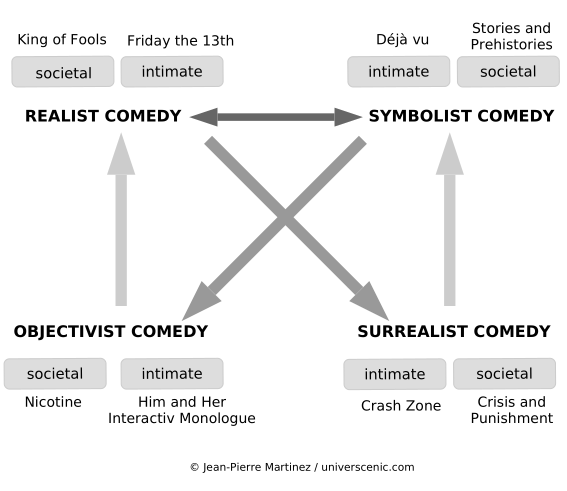
Jean-Pierre Martinez’s comedies, however, whatever genre they belong to, fall either within the sphere of the intimate and the private (personal, friendly, conjugal, familial…) or within the sphere of the public and the societal (professional, communal, political…).
Realist Comedies
Realist comedies are without doubt the most numerous in the theatrical work of Jean-Pierre Martinez. It is also the genre he explored most extensively during the first part of his career, for several reasons.
Realist comedy is a genre widely practised by playwrights and highly popular with audiences. It stands within the great tradition of Molière and Feydeau. It is also the theatrical genre whose codes are the most firmly established and therefore the most familiar to an author approaching dramatic writing for the first time. Realist comedy casts an ironic gaze upon the intimate or the societal sphere, and a distanced gaze upon life itself. It is not, strictly speaking, an easy genre, but it is a natural one, grounded above all in the observation of reality. To look at contemporary life with the eye of an anthropologist, a sociologist, or even an entomologist is already to begin writing realist comedy. Having come to writing through television screenplays, Jean-Pierre Martinez moved quite naturally from crafting popular comedies for the small screen to writing so-called “boulevard” comedies for the stage.
Moreover, for a beginning playwright hoping to turn his passion into a profession without first passing through the gatekeeping of the theatrical institution, realist comedy offers an obvious and immediate outlet. Professional and amateur companies are constantly in search of strong comic scripts that will allow them to fill theatres by entertaining their audiences. In selecting a comedy, these companies rely on instinct and on the simple reading of the text, whereas subsidised theatre, privileging drama or tragedy, selects only works by authors already validated by the institution through publication and/or reading committees.
Intimate Realist Comedies
Comedies of this type depict individuals in friendly (Friday the 13th, How to Get Rid of Your Best Friends, Back in the spotlight), conjugal (One Marriage out of two, The perfect son-in-law, Strip poker) or family relationships (Family Portrait, A Cuckoo’s Nest, Dead End Boulevard). Naturally, most of these plays blend these three dimensions, friendship, marriage, and family, while remaining within the sphere of the intimate.
Societal Realist Comedies
These comedies portray groups of individuals in a professional setting (A Simple Business Dinner, Reality Show), a community setting (Miracle at Saint Mary Juana Abbey, Welcome Aboard!, White Coats, Dark Humour), or a political one (The Most Beautiful Village in France, The Worst Village in England, King of fools ).
Whether they focus on the private or the public sphere, these comedies place ordinary individuals in extraordinary yet entirely realistic situations, thus facilitating audience’s identification with the characters.
Many of these realist comedies are also parodic, caricaturing the very codes of the genre to which they belong. Just Like a Christmas Movie exemplifies this perfectly, openly embracing its own parodic dimension through its title.
The most successful works of Jean-Pierre Martinez within this sphere of popular theatre belong to intimate realist comedy, notably Friday the 13th, Strip poker, and An Innocent Little Murder.
Surrealist Comedies
Having perfected his craft and established his reputation through realist comedies, Jean-Pierre Martinez then allowed himself to explore the genre of surrealist comedy. In many of his realist comedies, however, elements of the fantastic are already present, particularly in endings that open onto the irrational and the absurd. His surrealist comedies therefore merely extend the logic of development within this sprawling body of work which excludes no genre but, on the contrary, seeks to experiment with them all.
Intimate Surrealist Comedies
Comedies of this type fall within the sphere of private relationships: friendships (The Ways of Chance), marriage (A Brief Moment of Eternity), romantic relationships (New Year’s Eve at the Morgue) or family relationships (Crash Zone, Not Even Dead).
Societal Surrealist Comedies
These comedies portray groups of individuals in professional settings (Crisis and Punishment, The Joker, In Flagrante Delirium ), in social or high-society settings (Music Doesn’t Always Soothe the Savage Beasts), or within broader societal contexts (Quarantine).
Whether situated in the private or the public sphere, these comedies place ordinary individuals in situations that begin in the realm of the banal but quickly shift into the fantastic, into strangeness and the irrational.
Many of these surrealist comedies also transgress traditional theatrical codes to produce an additional comic effect, notably through mise en abyme. This is theatre-within-the-theatre (Is There an Author in the Audience?, Backstage Comedy, Heads or Tails, Preliminaries), even when this reflexive structure is not central to the dramatic principle or the comic effect of the play (Is There a Pilot in the Audience?).
Symbolist Comedies
It is in the later part of his oeuvre that Jean-Pierre Martinez explored symbolist comedy most extensively, partly because he then had the freedom to devote himself to less commercial plays, but also, no doubt, as the result of a personal journey that led him to reflect more deeply on the workings of the world and on the highly hypothetical meaning of life (drawing far more inspiration from recent scientific discoveries than from the endless and often unfounded speculations of philosophy).
This late interest in the symbolist genre also reflects a shift towards greater pessimism. To mock the flaws of ordinary people, as in realist comedy, requires a certain hope that by exposing those weaknesses one might still lead people to improve. It is a form of optimism tinged with scepticism. Confronting the absurdity of life head-on, as symbolist comedy does, is, on the contrary, to face a kind of despair… only lightly tempered by humour.
Intimate Symbolist Comedies
Comedies of this type belong to the intimate sphere: introspective relationships (Like a Fish in the Air, Happy Dogs) or conjugal relationships (Déjà vu).
Societal Symbolist Comedies
These comedies depict social groups, but this time within an alternative symbolic world (The Pyramids, Horizons), sometimes anchored in an imagined past (Stories and Prehistories, A Thwarted Vocation) or an imagined future (Surviving Mankind, Just a Moment Before the End of the World).
Some of these comedies also employ codes other than those of traditional theatre, for example reverse chronology (The House of Our Dreams).
Objectivist Comedies
The genre of objectivist comedy has been present in Jean-Pierre Martinez’s work from the very beginning, particularly through his many sketch-based comedies. This is an art of lightness and rapidity, allowing fleeting realities and transient situations to be captured in an original style. In sketches, characters generally have no psychological depth. The situation takes precedence, with an extremely brief plot, more anecdote than story, not embedded within a larger narrative, although the accumulation of these flash-narratives may ultimately amount to the exploration of a particular theme.
Intimate Objectivist Comedies
Comedies of this type portray individuals within friendships (The Rebels), convivial social interactions (Open Letters, Sidewalk Chronicles), family relationships (At the bar counter), or conjugal relationships (Him and Her).
Societal Objectivist Comedies
These comedies depict groups of individuals within professional life (Nicotine) or within social life more broadly (Open Hearts). Most of Jean-Pierre Martinez’s sketch-based comedies rely on the minimalist code characteristic of objectivist comedy. Some of these comedies also belong to theatre-within-the-theatre (Stage Briefs, Backstage Bits).
Part 2 From Modes of Representation to Types of Narrative
The typology of theatrical genres we have just defined is grounded in deep foundations: the opposition, through the semiotic square, of different ways of perceiving and representing the world. It operates at an axiological level, where theatre is understood as a formalisation of systems of values and relationships to reality.
It is nevertheless possible to propose another form of categorisation of theatrical works, more superficial in the structural sense of the term, by shifting the focus from values to narrative. This approach no longer seeks to question what the world is or should be, but rather the way theatrical narratives are organised and the moments of their dynamics that they privilege.
This second typology, necessarily less radical and less general, is no less relevant. It offers a complementary analytical perspective, more specific in nature, focusing on dramaturgical mechanisms.
These two classifications are therefore neither exclusive nor competing, but complementary: the first accounts for the major symbolic and ideological orientations of theatre, while the second explores its narrative and dramaturgical modalities.
Chapter 1: On the Quadrature of the Narrative Schema
Among the tools derived from Greimasian semiotics, the narrative schema and the semiotic square are those that have given rise to the greatest number of applications, particularly in the field of communication.
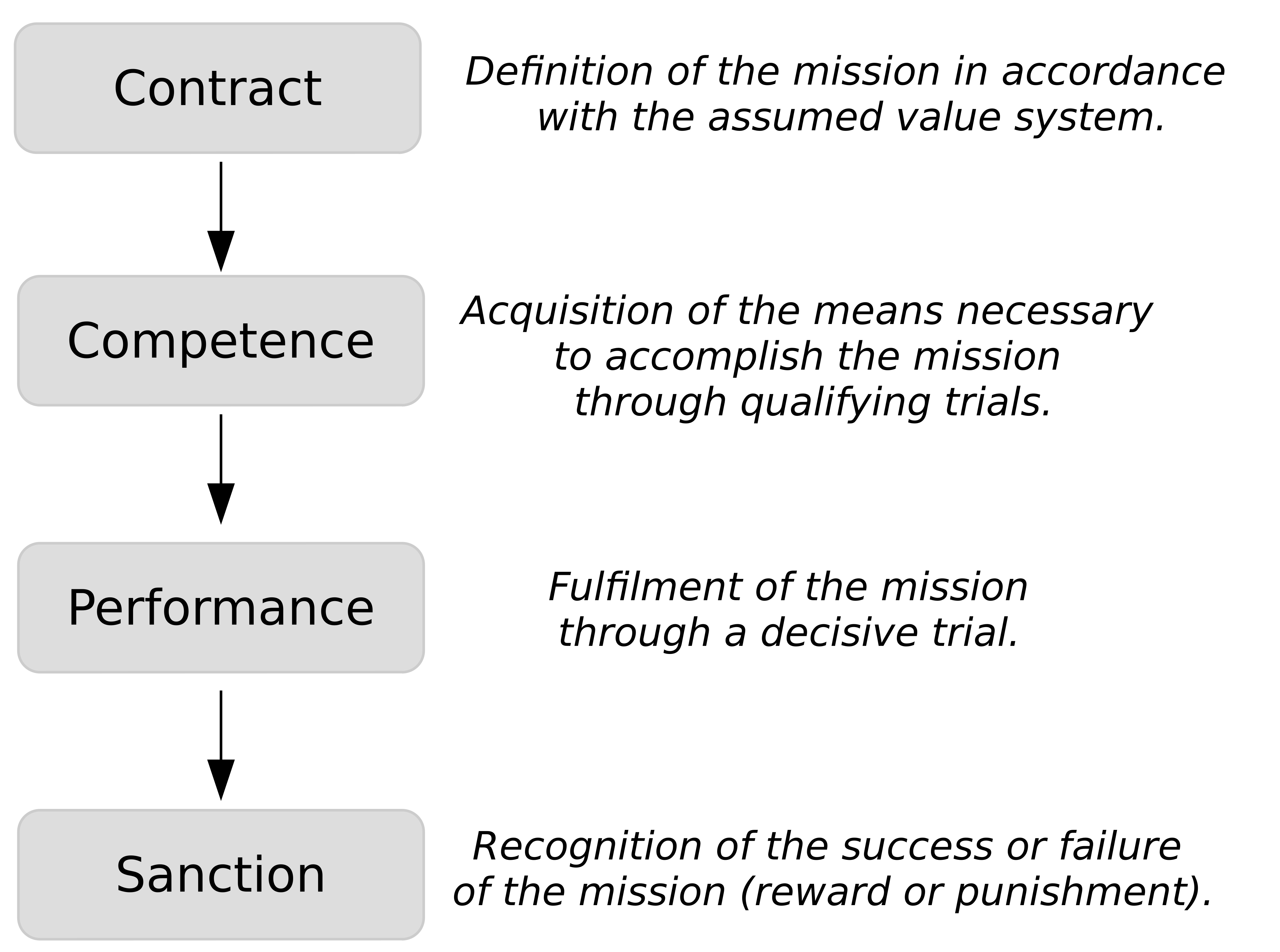
The narrative schema describes the dynamics of any narrative through four episodes:
The semiotic square, for its part, organises the system of values structuring a narrative according to a logical model of exclusive positions. In a Manichean ideological system, for example:
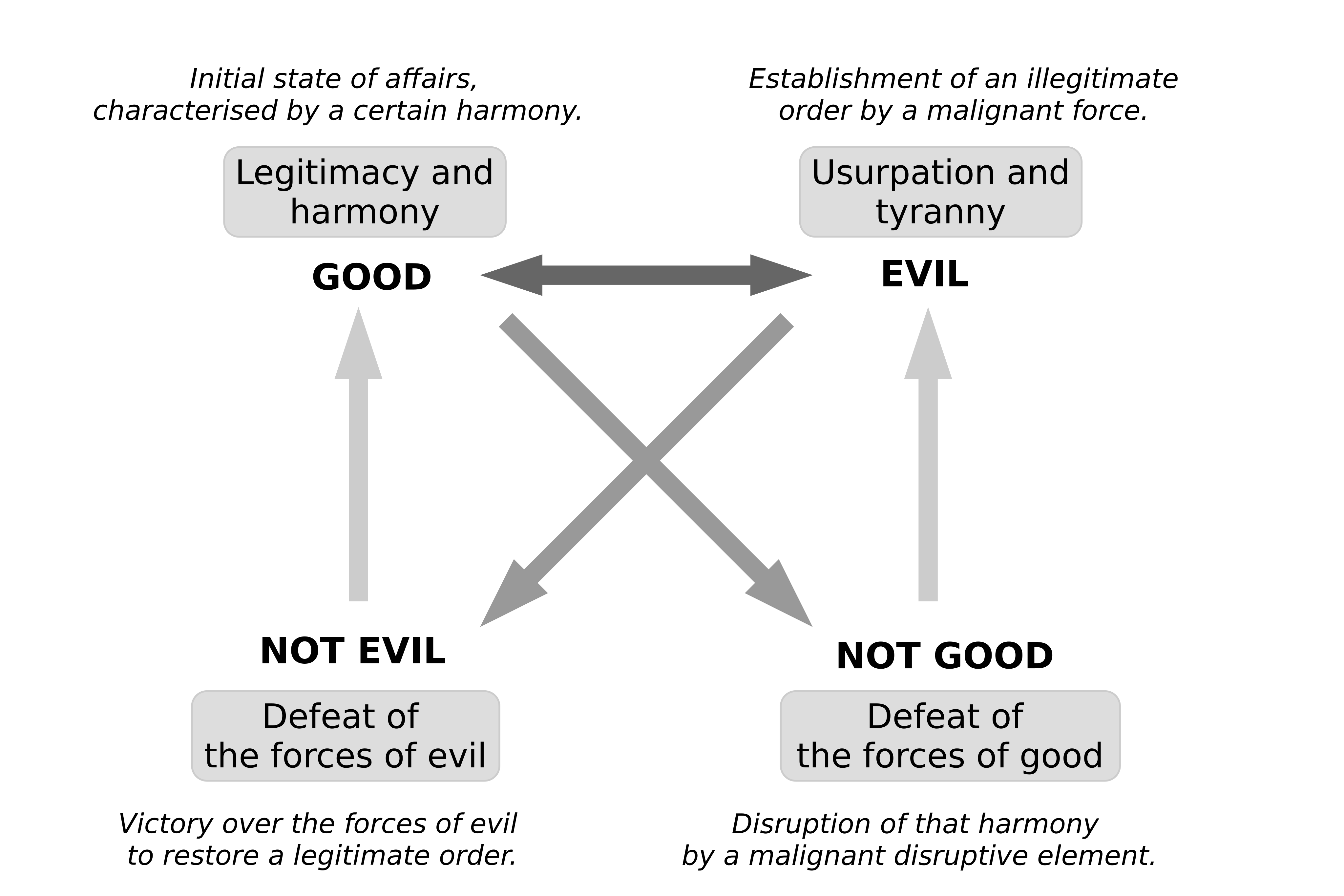
It is therefore conceptually tempting to attempt to project the four trials of the narrative schema onto a semiotic square. Yet such attempts have generally proved unconvincing, because the problem has been wrongly framed. The semiotic square belongs to a logical and paradigmatic process, whereas the narrative schema describes a diegetic and syntagmatic process, inscribed in the temporal unfolding of the story. One organises possible positions between which a choice must be made; the other organises episodes to be traversed in the logical progression of any narrative.
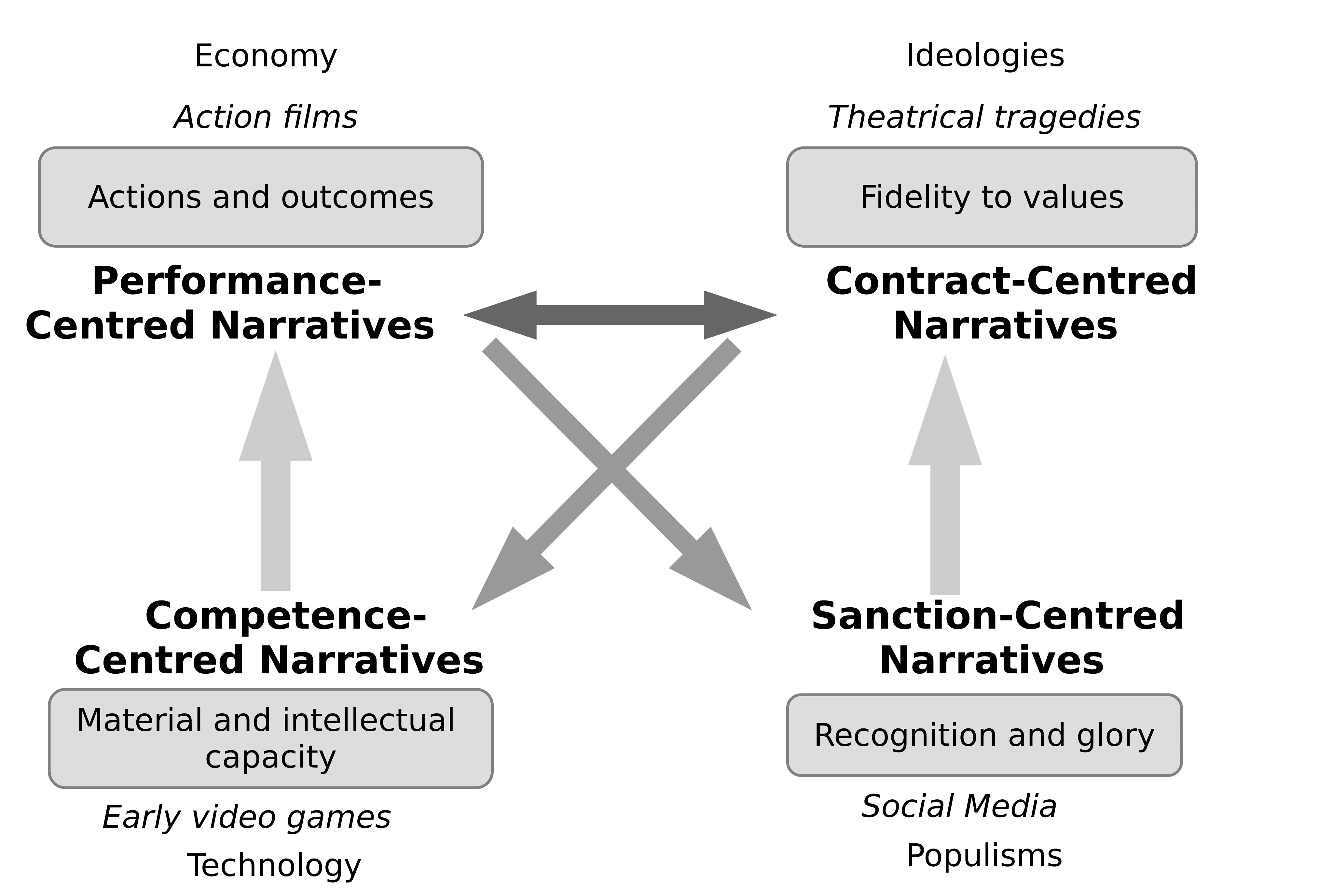
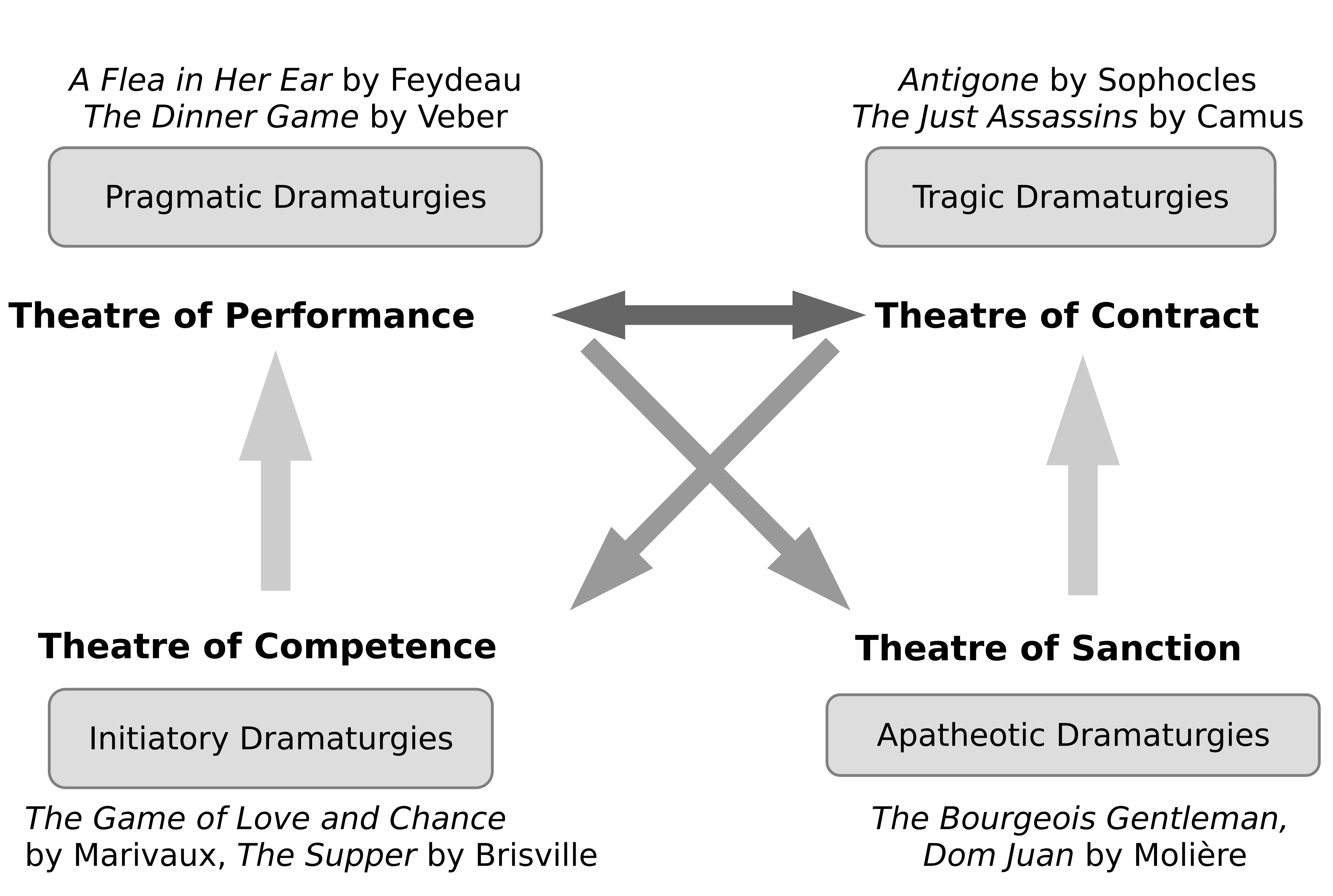
However, the hypothesis of a rigorous articulation between these two models becomes viable if we change the level of analysis. Rather than considering narratives of contract, competence, performance and sanction as successive and complementary moments in the unfolding of a story, they can be understood as predominant—sometimes even exclusive—episodes within a narrative, capable of defining a typology of narrative genres. These genres apply both to real narratives (political, social, media-driven) and to fictional ones (video games, cinema, theatre).
Chapter 2: The Four Narrative Genre
1. Contract-Centred Narratives
In contract-centred narratives, the story privileges fidelity to a system of values at the expense of other narrative dimensions. It matters little whether the subject possesses the means to fulfil their ambitions, achieves tangible results, or is recognised for their actions: what counts is adherence to a commitment perceived as superior.
This narrative genre historically structures great heroic and tragic narratives, as well as certain modern political narratives. The figure of General de Gaulle, as it emerged in the collective imagination of the Resistance, fully belongs to this regime: unwavering fidelity to one’s values, regardless of the chances of success, immediate results or contemporary recognition. From Joan of Arc to Zelensky, via Churchill or Che Guevara, history abounds with such heroic figures who rise against a far more powerful oppressor or invader, animated by the conviction that when a cause is just, good will ultimately prevail. Every founding national myth includes an icon of this kind.
In contract narratives, ethics therefore prevail over qualification and action, and even potential failure can be excused, on the assumption that history is more likely to forgive defeat than dishonour.
In fiction, these narratives are particularly present in ancient and classical theatre, as well as in modern tragedy. In tragedy, it is precisely the hero’s unconditional fidelity to their values that inevitably leads to their downfall.
2. Competence-Centred Narratives
Competence-centred narratives privilege mastery, power and virtuosity—whether physical or intellectual. Competence is valued for its own sake, independently of the ideology it serves, the results it produces, or the recognition it generates.
This genre structures a significant part of contemporary media narratives related to technocracy, economics, technology and innovation. Major figures in new technologies (such as Elon Musk prior to his official political engagement) exemplify this regime: demonstrating omnipotence, pushing back limits, exploring all possibilities before even asking what concrete purpose they might serve.
On the international political stage, Europe also represents this figure of power that fails to translate into meaningful action, due to divisions over values and the absence of a fully legitimised executive authority.
In fiction, competence narratives find a particularly clear expression in early video games, where the essential goal is to demonstrate mastery, progress through levels, and increase power. Largely devoid of genuine diegesis, ideological stakes or symbolic recognition beyond the score, these games rely almost exclusively on qualifying trials and progression through failure. The player’s value is measured neither by the correctness of their choices nor by the final outcome, but by their ability to endlessly improve their competence.
3. Performance-Centred Narratives
Performance-centred narratives privilege effective action and the achievement of objectives. The value of an act is measured exclusively by its result. Values, means and recognition are relativised. This is the culture of results.
This genre structures narratives of technocratic management and pragmatic politics. It appears in many managerial discourses and in figures of leaders defined above all by their ability to “make a system work”. On a geopolitical level, Chinese leaders (notably Xi Jinping) emphasise this logic of performance stripped of revolutionary political ideology: stability, growth and efficiency, independently of declared values or external judgement. In contemporary China, as in post-war Japan, performance seems to have become an ideology in itself, and the cult of results a new form of religion.
In fiction, this regime corresponds notably to the action film, where only the accomplishment of the mission matters, action becoming an end in itself, independent of the defence of any particular value system.
4. Sanction-Centred Narratives
Finally, sanction-centred narratives privilege recognition. Whether the action is just or unjust, coherent or chaotic, effective or not is of little importance: the only thing that matters is the verdict delivered by society and the glory acquired by the “hero”.
This genre increasingly structures contemporary narratives, particularly within the universe of social media, where symbolic existence depends exclusively on the gaze of others. Certain more or less ephemeral celebrities thus appear to be founded solely on de facto notoriety, completely disconnected from values, competence or meaningful action.
This obsession with recognition, born of social networks, has now also invaded the political sphere with the advent of populism, based primarily on unconditional popular endorsement, independently of concrete results, verified competence, or stable ideology. The figure of Donald Trump illustrates this regime well: media recognition, captured attention and symbolic status matter more than ideological coherence, competence, or even objective results. In this genre, sanction is no longer a resolution; it becomes the driving force of the narrative. Action is subordinated to the expectation, provocation or manipulation of others’ judgement.
In this domain, it becomes difficult to distinguish reality from fiction, since everything is done to turn reality into fiction—or fiction into reality. We are here in the realm of conspiracy thinking and alternative truths, inseparable from social networks as organs of information and disinformation, as fictional media, and as political arenas.
Chapter 3: Narrative Genres and Theatrical Genres
These four narrative genres do not merely account for political or media narratives; they also profoundly structure the history of theatre.
1. Theatre of Contract
Contract narratives underpin the great tragic dramaturgies, from Antigone to modern figures of absolute fidelity to an ideology. In The Just Assassins by Albert Camus, for instance, everything is prepared for an action (an assassination) that ultimately does not take place. The subject of the play is therefore not the unfolding of an action, but the debate over its legitimacy, insofar as the context undermines its moral validity.
2. Theatre of Competence
Competence narratives underpin great initiatory dramaturgies: learning about life, mastering emotions, social rules and language. Marivaux, notably in The Game of Love and Chance, exemplifies this genre, in which action matters less than the characters’ initiatory journey. In a different way, The Supper by Brisville relies less on an almost non-existent action than on the linguistic virtuosity of the two protagonists in their verbal duel.
3. Theatre of Performance
Performance narratives underpin pragmatic dramaturgies. In this type of narrative, everything rests on the principle of frenetic chains of causes and effects, actions and reactions, with little concern for ideological frameworks, the protagonists’ qualifications, or even the final outcome, which may remain open. This is notably the case in situation comedy, boulevard theatre and farce. The theatre of Georges Feydeau perfectly illustrates this type, with plays such as A Flea in Her Ear or A Tailor-Made Affair. A comedy like The Dinner Game by Francis Veber also exemplifies this genre, based on the principle of an endless chain reaction triggered by a more or less insignificant initial disturbance.
4. Theatre of Sanction
Sanction narratives underpin great apotheotic dramaturgies: the pursuit of social recognition, notoriety, celebrity and glory. Many of Molière’s comedies are based on this illusory quest for social consideration (The Bourgeois Gentleman, The Learned Ladies). The represented world functions as a permanent tribunal, where any disapproval is equivalent to a symbolic death. In his own way, Dom Juan is also in search of a sanction—both paternal and divine—like a child whose misbehaviour seeks punishment in order to reassure himself of the effective existence of an authoritative figure.
Chapter 4: Narrative Genres in the Theatre of Jean-Pierre Martinez
The theatre of Jean-Pierre Martinez is distinguished by the fact that it does not occupy a single position, but explores all of these narrative genres.
1. Dramaturgy of Conscience: The Rope
Here, conscience is understood as the assumption of a system of values. “Science without conscience is but the ruin of the soul,” wrote Rabelais. In other words, all power—especially when absolute—must be governed by moral principles, or it becomes tyranny. We are here in the realm of the confrontation of ideas and values.
The Rope by Jean-Pierre Martinez is structured around a moral controversy. A doctor and a priest debate whether strict fidelity to the ethical rules of their respective professions should prevail when lives are at stake. In other words, should obedience to the law take precedence over justice in the broader sense? And does one have the right to sacrifice one life to save several others?
2. Dramaturgy of Qualification: Running on Empty
This is a theatre of doubt and self-questioning, in which the protagonist questions their ability to continue their mission or is required to prove their competence anew.
Running on Empty is structured around a loss of competence. A playwright at the end of his rope, lacking both inspiration and motivation, is confronted by a mysterious visitor who manipulates him into regaining his creative capacity. The reasons why this author should return to his typewriter are deliberately portrayed as trivial, as is the recognition he might gain from writing yet another play. The performance—the actual writing of the masterpiece—takes place only after the end of the play. The only thing that matters is the restoration of the author’s creative power.
3. Dramaturgy of Action: The Jackpot
This is a theatre of situation, intrigue and quest—even (and perhaps especially) when the object of the quest has no significant value. This insignificant grail is what screenwriting theory calls a MacGuffin: that which the hero pursues and which sets them in motion without carrying any ethical or symbolic weight.
The Jackpot is structured around the quest for a valuable object in the literal sense: a winning lottery ticket, initially lost after its owner’s death, and later discovered to have been buried with him. It does not matter what the prize might be used for. It does not matter that none of the claimants have done anything to deserve it. The sole driving mechanism of the play is the infernal chain of actions and reactions that ultimately leads to the discovery that the winning ticket is not at all where it was being sought.
4. Dramaturgy of Legitimacy: Cheaters
This is a theatre of appearances and of true and false recognition: overly discreet or unjustly ignored heroes, assumed postures and impostures, undeserved celebrity. Are those whom the media present to us as the heroes of our time truly the most legitimate?
In Cheaters, social recognition is the central stake. A successful novelist who has usurped the authorship of a work for which he has just received a prestigious literary prize is visited by a woman who claims to be the true author. Everything now revolves around a debate on the notion of literary glory and fortune. Who truly deserves them? The one who wrote the book, or the one who succeeded in having it recognised as a masterpiece? Truth matters less than appearances, and justice less than those who dispense it.
What gives coherence to Jean-Pierre Martinez’s work is therefore not a single style, but an exploratory approach: each play puts a narrative genre to the test, revealing its logic and its comic or tragic effects.
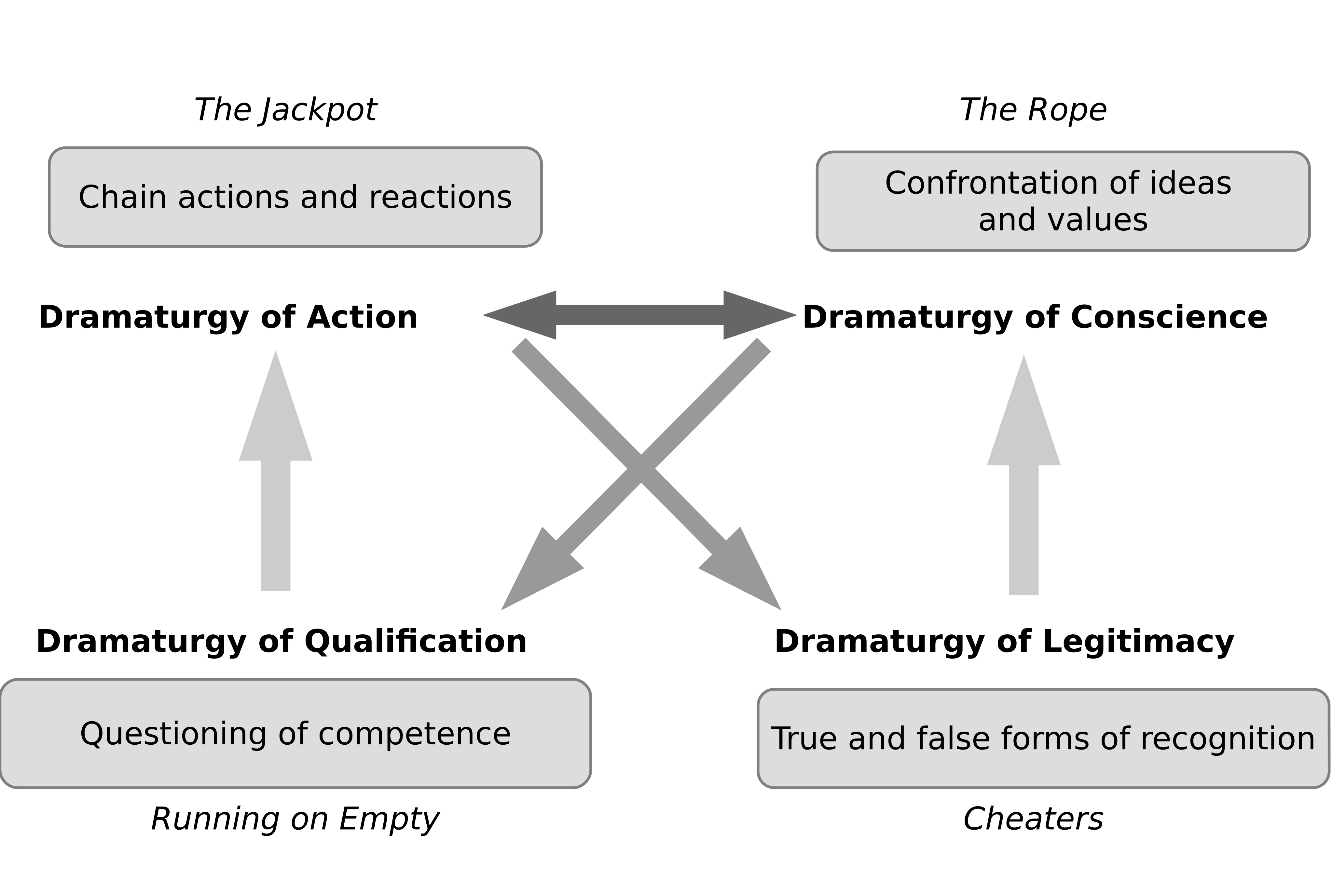
By reconsidering the four episodes of the narrative schema as defining four narrative genres, and by organising them within a semiotic square, it becomes possible to propose a general model capable of accounting for major socio-historical narratives, contemporary media discourse, and theatrical genres alike.
Theatre thus appears as a privileged laboratory in which these regimes are tested, where tensions between value, power, efficiency and recognition are played out. Of course, not all plays exploit a single narrative episode exclusively, but the dominant genre is the one that conditions the primary dramaturgical tension. And it is precisely this dominance that determines a work’s affiliation with a given genre—and its originality.
Jean-Pierre Martinez’s theatre, through its systematic exploration of all these narrative genres, offers a particularly fertile field of observation.
An Invitation to Travel, in the Form of a Map
At the end of this analysis, it is important to emphasise once again that this typology of theatrical genres is by no means normative. Just as a map does not compel the traveller to take only toll motorways, leaving them free instead to follow country roads or even footpaths, this dramaturgical cartography merely offers a few orienting landmarks. It was only after writing 120 plays that I myself felt the desire, retrospectively, to formalise my own writing process, as a systematic exploration of the possibilities of theatrical form.
One may practise dramaturgy, just as one writes prose, without realising it; but that simply means one is instinctively applying dramaturgical rules. It does not mean such rules do not exist. In music too, one may play by ear without knowing solfège. One may even challenge the Western conventions elevated to dogma by classical music, but one cannot entirely ignore the rules of harmony. What matters is to play in tune, and that the piece composed is pleasant to hear, perhaps even moving or inspiring.
People often refer, somewhat dismissively, to “genre theatre”, as opposed to the supposedly unclassifiable “new theatrical writings” that are meant to serve as the new grail for contemporary playwrights seeking institutional recognition. But every play belongs to a genre, whether ancient or relatively recent. And any play belonging to a new genre, one invented by its author, is destined eventually to become “genre theatre” once the innovations that once defined it have been worn thin by those who believe themselves avant-garde merely by imitating genuine pioneers.
After Writing One’s Life, an autofiction recounting my path into literary creation, this short essay in self-analysis is also intended as a toolbox for aspiring playwrights. Here is the highly imperfect map I have drawn for you, after exploring for myself this dramaturgical territory of which we are all inhabitants. It is up to you to choose your destination and your route. Bon voyage!