
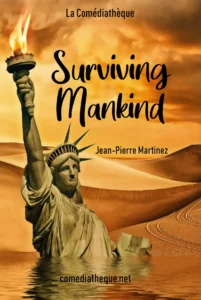
Surviving Mankind is an ecological tragicomedy in which Jean-Pierre Martinez stages, within the confines of a spaceship, humanity’s final decision as its world collapses. The play brings moral discourse, power struggles, and intimate tensions into confrontation as four survivors debate whether an annihilated humanity deserves to continue. Oscillating between political satire and existential meditation, Martinez questions the legitimacy of salvation, the burden of legacy, and the repetition of historical mistakes.
Dialogue is the central instrument of the play — a forum where ethics are tested, and where survival itself becomes a collective trial.
Introductory Summary – A Semiotic Perspective
In Surviving Mankind, the spaceship becomes a semiotic laboratory where the entire human story contracts into its final hour. The Ark, drifting through an emptied universe, is less a technological vessel than a symbolic space in which discourses, values, and worldviews collide. The four survivors—Adam, Eve, Romeo, and Juliet—do not merely embody characters: they function as ideological voices, carriers of distinct modes of reasoning (scientific, military, existential, philosophical).
Within this claustrophobic setting, survival itself becomes a moral tribunal, and the end of the world a stage for examining the foundations of meaning, responsibility, and human agency. By privileging dialogue over action, Martinez transforms the impending extinction of the species into a debate about the legitimacy of salvation. The Ark thus becomes a meta-signifier: a space where humanity questions not how to live, but whether life deserves to go on.
1. The Level of Enunciation: Figures and Represented World
The represented world is a drowned Earth: a boiling ocean, scattered with debris and corpses, where no land remains. This setting is not merely descriptive; it forms an isotopy of ending, of the dissolution of forms, systems, and narratives. Against this backdrop, the four protagonists appear as semiotic figures:
-
Romeo, the soldier, embodies pragmatic force and the discourse of survival at any cost.
-
Juliet, the scientist, carries the burden of rational responsibility, oscillating between lucidity and emotional fragility.
-
Eve, disillusioned yet compassionate, expresses ethical hesitation and existential weariness.
-
Adam, the doctor-philosopher, champions the radical thesis that humanity should not be saved.
As figures, they do not represent psychological realism but ideological positions. Together, they restage the internal conflict of humanity: preservation versus renunciation, instinct versus ethics, memory versus oblivion. The Ark becomes not just a vessel but a last agora—a symbolic space in which the final decision of the species must be articulated through language.
The plot unfolds as a confrontation between incompatible moral visions: save humanity, let it die, or merely try to survive individually. This dialogic economy is the essence of the dramatic tension.
2. The Level of Enunciation: How Meaning Is Produced
a. Polyphonic Structure
The text is built on a constant ideological tension. Each character speaks from a stable ethical or philosophical position, and the meaning of the play arises not from action but from the collision of these discourses.
b. Structural Irony
Irony saturates the dialogue: jokes about reproduction, survival, and reality TV work as distancing devices. This humor is not decorative—it exposes humanity’s contradictions at the moment of its extinction.
c. Double Address
While characters address one another, their words clearly reach a higher addressee: the spectator. The audience becomes the implicit judge of the final verdict on mankind.
d. The Technical as Counter-Discourse
Checklists, countdowns, cryogenic protocols, missile launches—these are not just plot elements but function as an impersonal language within the play. The mechanical, procedural idiom forms a semiotic counterpoint to human passion.
e. Fractured Temporality
The flashback reveals that enunciation is unstable: the narrative reorients itself, reconstructing past actions and motives. The spectator discovers that the meaning of events shifts retroactively.
3. Denotation: What the Play Literally Shows
The denotative layer is precise and quasi-scientific:
-
A fully submerged Earth.
-
A cracked launch silo filling with boiling water.
-
A prototype rocket equipped with cryogenic pods and missiles.
-
Strict technical procedures, countdowns, and cockpit operations.
-
A sixteen-thousand-year interstellar journey.
-
A failed cryogenic process for two crew members.
-
A return to an unexpectedly habitable Earth.
This meticulous denotation provides the literal grounding for the play’s symbolic interpretations.
4. Connotation: What the Play Suggests
a. The Ocean as Primordial Chaos
The Earth reduced to a single ocean evokes not the Genesis but its inversion: un-creation, liquidation of history, a return to undifferentiated matter.
b. The Ark as Inverted Myth
Rather than a divine means of salvation, The Ark becomes a morally ambiguous refuge for the very species responsible for planetary devastation.
c. Adam’s Proposed Sterilisation
This symbolic gesture pits Thanatos against Eros: a radical ecological ethic that frames extinction as the only moral horizon.
d. The Final Return
Earth’s regeneration after sixteen millennia suggests a cosmological irony: nature heals without mankind. Humanity is revealed as neither necessary nor central.
5. Typological Positioning: A Societal Symbolist Comedy
Within the dramaturgical taxonomy defined by Jean-Pierre Martinez, Surviving Mankind is a quintessential societal symbolist comedy.
It is a comedy, not because it aims to amuse, but because it uses humor as a critical instrument. Jokes about extinction, reproduction, and human folly create a distancing effect that allows the spectator to confront the apocalypse without emotional paralysis.
It is symbolist in its reliance on emblematic spaces and figures: the Ark as a mythic vessel, the boiling ocean as planetary punishment, cryochambers as suspended time, and the interstellar voyage as a metaphysical trial. Every physical element is overloaded with symbolic resonance.
It is societal because the four protagonists are embodiments of contemporary ideological conflicts: military authority, scientific rationalism, ecological radicalism, moral skepticism. The Ark becomes a compressed society in which the ethical failures and contradictions of modern humanity are reenacted.
Thus the play perfectly embodies the societal symbolist comedy:
a form that uses irony and symbolic architecture to examine collective dysfunctions and to question the meaning of civilisation at its breaking point.
6. Global Semiotic Logic
The play rests on an implicit semiotic square: Save/ destroy humanity – More life/ Less life
Martinez deploys also the three ontological dimensions central to his semiotic dramaturgy:
-
Virtual: Y214, the imagined refuge.
-
Actual: the debate aboard the Ark.
-
Real: Earth’s unexpected renewal and the final descent.
Meaning arises in the oscillation between these levels: from possibility, to decision, to revelation.
7. Conclusion: A Moral Fable Without a Moral
Surviving Mankind is more than a piece of science fiction—it is an existential meditation on extinction, hope, and the limits of human discourse. The dialogic structure foregrounds the contradictions of modern civilization, its failures, and its irrepressible desire to justify itself.
The final image—Adam and Eve preparing to re-enter the world, suspended between rebirth and repetition—encapsulates the play’s central question:
Will humanity restart differently, or merely begin again?
Martinez offers no answer.
He leaves the spectator with the unsettling realization that, in the end, the greatest uncertainty is not the planet we land on—but the species we bring with us.
Academic References on Surviving Mankind
-
“Ecocritical Analysis of Jean-Pierre Martinez’s Après nous le déluge,” Catherine Colette KEBAPCIOĞLU, Master’s thesis, Department of French Language and Literature, Hacettepe University, Ankara (2022). PDF available on the university website.
-
“Jean-Pierre Martinez and His Work Après Nous Le Déluge,” by İsmet TEKEREK, Translation and Interpretation – French Section, supervised by Dr. Dilber ZEYTİNKAYA, Istanbul (2025). PDF available on Universcenic.
-
“The Theatre of Jean-Pierre Martinez: A Scenic Exploration of ‘Climate Fiction’ through Après nous le déluge, Juste un instant avant la fin du monde, and Un petit pas pour une femme, un pas de géant pour l’Humanité,” by Nancy Hassan Mohamed Moussa, Lecturer at DLLF – Faculty of Girls, Ain Shams University, Egypt. Link to article available on Universcenic.
Usage rights — citation
Any use of excerpts or content from this analysis must include proper source citation.