
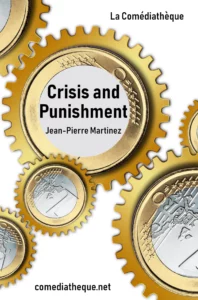
With Crisis and Punishment, surrealism does not arise from private turmoil but from the derailment of the public and societal sphere. The play begins with an apparently realistic situation: an unemployed actor is hired by a bank on the brink of collapse. But very soon, the logic of reality in general, and of the economic world in particular, begins to unravel. Procedures lose coherence, roles are reversed, decisions slide into absurdity. This progressive distortion transforms a realist setting into a surreal mechanism that exposes, through exaggeration, the everyday madness of the system. This is the hallmark of societal surrealist comedy: a distortion of reality that reveals its most paradoxical dimension.
1 – Analysis of the play Crisis and Punishment
The utterance follows a simple trajectory: a failed and rather naïve actor is designated as the scapegoat responsible for a financial disaster far beyond his control. Yet at every stage of the story, this sacrificial victim sinks further into a maze of contradictory injunctions and nonsensical procedures, alongside characters who seem just as overwhelmed as he is by the institution they represent. The comedy springs from the constant gap between what ought to be rational (management, hierarchy, economic logic) and what that supposed rationality becomes on stage: a puppet theatre where nothing makes sense anymore, yet everything remains perfectly coherent and even “regulation-compliant.”
The enunciation heightens this distortion of the real. Scenes unfold like the successive stages of an administrative nightmare with Kafkaesque overtones, where every interaction appears to obey a rule understood by everyone… except the audience and the protagonist with whom the spectator is invited to identify, since the story is experienced from his perspective. The realism of the dialogue merges with a kind of shifting dissonance that gradually pushes the action toward the absurd, without ever lapsing into gratuitous nonsense. The surrealism derives from the establishment of an alternative logic that merely reveals the absurdity inherent in ordinary logic.
Through its connotation, the play offers a satire of the contemporary world by way of the banking sector: the cruelty of financial capitalism, institutional irresponsibility, the cynicism of power, class selfishness, the cult of performance, and the precarisation of labour. Yet this critique remains embedded within comedy and never slips into militant pamphlet or moralising discourse. The scapegoat himself is not without flaws: through his insignificance and his cowardice, he is partly responsible for what befalls him.
In this societal surrealist comedy, the spectator laughs first at the strangeness of the story… only to realise that the situation is eerily familiar, and that, to some extent, they recognise themselves in this victim of the system. Unless, of course, they recognise themselves instead in the tormentors…
2 – Dramaturgical Analysis
Dramaturgical structure
The dramaturgy unfolds in a spiral progression, with each scene intensifying both the absurdity of the system and the protagonist’s loss of autonomy. The single location, an impersonal office, becomes a ritual space in which the same pattern is endlessly reenacted: summons, humiliation, rationalisation. Martinez subverts the conventions of the Theatre of the Absurd by grounding them in socio-professional realism: managerial phrasing, an implacable hierarchy, and technical vocabulary used to justify the unacceptable. The title, a playful pastiche of Dostoevsky, immediately introduces a game of guilt and fault: here, punishment precedes the crime. The comedy arises from the gap between administrative seriousness and the physical violence inflicted on James. The final slide into dream reinforces the ambiguity: psychic nightmare or dystopian reality?
Characters construction
The characters embody social functions rather than complex psychologies.
James, the protagonist, represents the precarious individual — vulnerable, malleable, both victim and unwitting accomplice of the system. His identity as an actor becomes a metaphor for the contemporary employee, “forced to play a role.”
Dom, the cynical manager, embodies cold authority, capable of justifying violence through pseudo-rational discourse. The character’s stage gender fluidity reinforces the symbolic nature of their function.
Sam, the assistant, stands for bureaucratic conformity and docility.
The clients (Margaret, Agnes, etc.) form a gallery of disciplinary figures, oscillating between anger, madness, and vengeance. They materialise the system’s violence upon the body.
Stylised in this way, these characters acquire an allegorical force.
Structure and Narrative Dynamics
The play follows a repetitive, ascending structure: each new client increases the level of violence, and each of Dom’s orders deepens James’s servitude. This repetition creates the effect of an inverted liturgy, bordering on dark farce. The narrative advances less through action than through the intensification of the same disciplinary pattern.
Shifts in tone — trivial humour, administrative cynicism, looming tragedy — generate a constant oscillation between comedy and unease.
The final intrusion of dream or hallucination blurs the boundary between reality and fantasy, opening the door to a metatheatrical reading: the stage becomes a space where socio-economic violence is ritualistically exorcised.
The rhythm, tightly controlled, relies on rapid-fire dialogue, ritualised gestures (the slap, the red button, the movement toward the urn), and recurring information loops that pace the dramatic escalation.
Significance of the Work
Crisis and Punishment offers a sharp critique of institutional violence in contemporary economic systems.
The play dissects how financial crises redirect responsibility downward: those with little power absorb the frustrations created by those above them.
By transforming James into a “professional martyr”, the banking institution reactivates an archaic mechanism — the scapegoat — but cloaks it in the vocabulary of modern management.
Martinez questions:
- the dehumanisation of workplace relations
- the psychological manipulation embedded in corporate culture
- the sacrificial logic disguised as efficiency
- the perverse blending of morality, guilt, and productivity
The humour does not soften the political content; it intensifies it by revealing the absurd core of systems that claim to be rational. The blurring of dream and reality suggests that contemporary labour is not merely a social space but also a psychic environment — one capable of becoming a nightmare internalised.
Usage rights — citation
Any use of excerpts or content from this analysis must include proper source citation.