
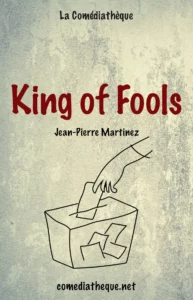
With King of Fools, realism anchors itself in the mechanisms of the social and political world. The play portrays ordinary people—Patrick White, a humble driver, and the office staff surrounding him—caught in the gears of a partisan electoral machine far beyond their control. Nothing in the story belongs to fantasy or symbolism: the plot feeds on internal rivalries, communication strategies, shifting alliances, and personal ambition. This slightly amplified portrait of how a political party works behind the scenes places the play squarely in the realm of realist societal comedy. The humour arises from an uncompromising critique of politics as shadow theatre.
1. Analysis of the play King of Fools (Semiotic)
The narrative is built on a simple yet explosively rich premise: as part of a strategy that is equal parts Machiavellian and reckless, a somewhat clueless man—an unremarkable driver with a questionable record—is chosen by his party to run for president, not to win, but to lose. His defeat is meant to pave the way for another, secretly chosen outsider candidate. This “designated fool,” thrust into the race against his will, finds himself at the centre of a presidential campaign driven by manipulation, contradictory polling, and cascading twists.
Comedy emerges from this barely distorted mirror held up to society. The audience recognises in the situations and characters the all-too-familiar backstage world of contemporary politics, built on spin, deception, and spectacle. But they also recognise themselves in the fictional electorate—their naivety, their contradictions, and their volatility. We do not laugh only at the politicians (which would reduce the play to a simplistic “they’re all rotten” populism); we laugh, perhaps even more, at ourselves.
The enunciation remains faithful to realist conventions: unity of place, linear temporality, fast, credible dialogue, and the absence of grand theatrical effects. We are unmistakably inside a campaign headquarters where ideology fades behind marketing strategy. Language is performative. Every character speaks to act, convince, manipulate, or protect themselves. This “life-sized” writing amplifies the realism: politics is revealed not as a grand ideological narrative but as a series of small power struggles between professionals sometimes overwhelmed by their own improbable schemes.
On the level of connotation, the play offers a bittersweet satire of democratic systems: fascination with image, instrumentalisation of individuals, obsession with results, fragility of convictions when confronted with personal interest. Without ever slipping into pamphlet, it humorously exposes the grey zones of a world where each person projects their own cynicism onto others. Here, laughter becomes a tool of analysis, creating enough distance to soften what would otherwise be too brutal or too bleak.
King of Fools thus perfectly embodies the realist societal comedy, showing—without caricature—how politics functions when seen from the perspective of those who pull the strings. It is a lucid portrait of the theatre of power, but also a discreet call for individual responsibility. After all, we end up with the leaders we deserve…
2. Dramaturgical Mechanics
The play is built on a central principle: modern politics operates as spectacle, where truth matters far less than efficient storytelling. Martinez adopts a satirical tone—swinging between burlesque and darkness—to reveal the absurdity of a system capable of turning a driver into a presidential contender. With no illusions, the play embraces the theatrical nature of power: staging, framing, talking points, communication strategies. Comedy lies in the gap between Patrick’s apparent simplicity and the destructive intelligence of those around him.
Characterisation
Patrick White : The quintessential innocent, reminiscent of anti-heroes from satirical literature. His role is not to act but to reveal, through contrast, the cynicism of the system.
Vanessa: Embodiment of instant communication and image culture—a ruthless influencer who rides every wave.
Dominique Riviera : A brilliant communicator, the true dramaturge of power, sculpting narratives with surgical precision.
Alex Chatterton: A Machiavellian advisor, expert in strategic manipulation.
Claude de Casteljarnac: A high-ranking figure of the establishment—cold, entitled, and unshakably self-assured.
Fred Uberman: A shadowy operator, mediator between official and unofficial power structures.
Together, they form a miniature political ecosystem—a satirical mirror of real-life power networks.
Structure and Narrative Dynamics
The dramatic structure follows a steady escalation:
- Introduction of the innocent
- Revelation of the political scheme
- Alliances and manipulations
- Unexpected reversals
- Final collapse and return to reality
Each scene adds another layer of deception. The tension builds through accumulating contradictions and the gradual unveiling of hidden agendas. The single setting reinforces the sense of a political chamber drama, while the quick, media-like dialogue sustains the rhythm.
Scope and Significance
Beyond comedy, King of Fools reflects on the nature of contemporary power. The play examines the porous border between politics and fiction, showing how official narratives are crafted by professionals of image and influence. It also questions the place of the individual within such a machine: Patrick is representative of those who are elevated, consumed, and then discarded.
Jean-Pierre Martinez situates the play within the European tradition of political satire—an heir to Molière, but also to British farce and satirical television comedy. Through excess, the play reveals reality.
Usage rights — citation
Any use of excerpts or content from this analysis must include proper source citation.